
Space Heater Electricity Cost Calculator: Cost per Hour, Day & Month
Researched and reviewed by Dustin Sosko
Published: October 10, 2026
A small heater used throughout your workday can cost less—or more—than a higher-wattage heater used for shorter sessions. The answer depends on wattage, electricity price, operating hours, and how much of that time the heater actively produces heat.
Use this space heater electricity cost calculator to compare two heating routines. See estimated costs per active heating hour, per use day, and per month, alongside a continuous-heating maximum for each schedule.
You can also enter a monthly spending limit to estimate how many active heating hours that budget could cover.
Compare Two Space Heater Routines
What would these two routines cost?
Compare electricity use, monthly costs and a budget using your own assumptions.
Estimates cover the entered heating wattage. Off-cycle fan, standby power, varying rates and other appliances are excluded. The maximum assumes 100% heating at the entered setting for the entered schedule. Equal costs do not mean equal comfort or room-heating performance.
Thermostat cycling is your assumption. This calculator cannot predict the percentage of time a heater will actively heat from room size alone.
The results estimate electricity costs at the wattage and rate you enter. Matching costs do not mean matching comfort or room-heating performance.
How to Use the Calculator
Enter the Wattage at Your Selected Heat Setting
Use the wattage shown in your heater’s manual or specifications for the setting you plan to use.
For example, if a heater offers separate 600-, 900-, and 1,500-watt settings, enter the setting you intend to select. You can enter custom values rather than choosing from a fixed list.
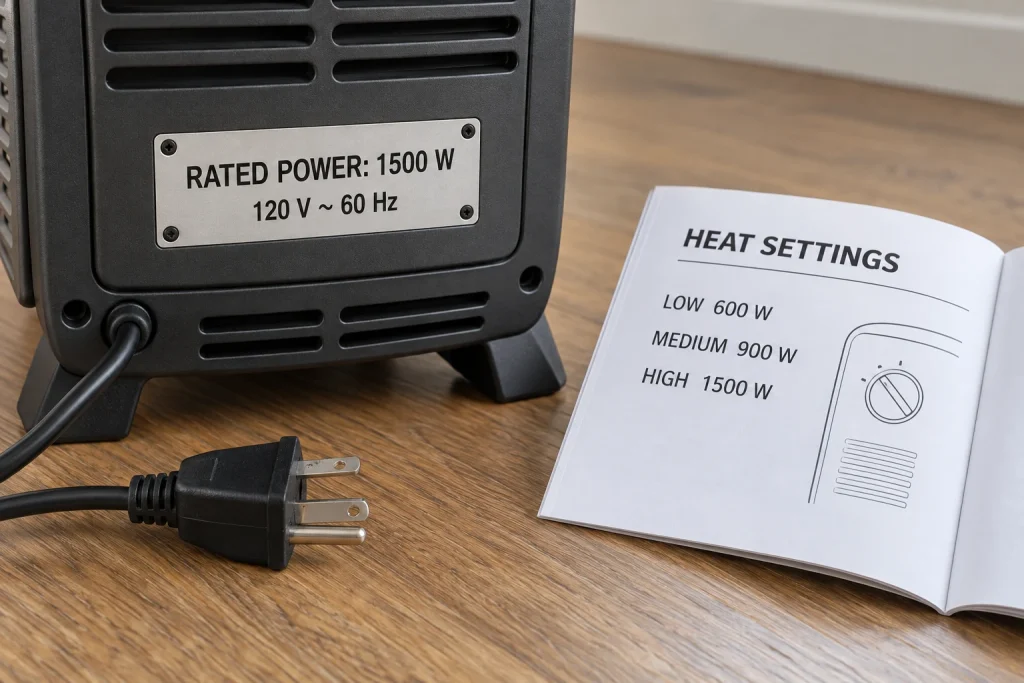
If you only know the maximum wattage, enter that value and use 100% actively heating for a continuous-heating estimate.
A mode labeled “ECO” does not necessarily correspond to one fixed wattage. If your heater changes heating levels automatically, one wattage and cycling percentage can only approximate its operation.
Enter Your Electricity Price
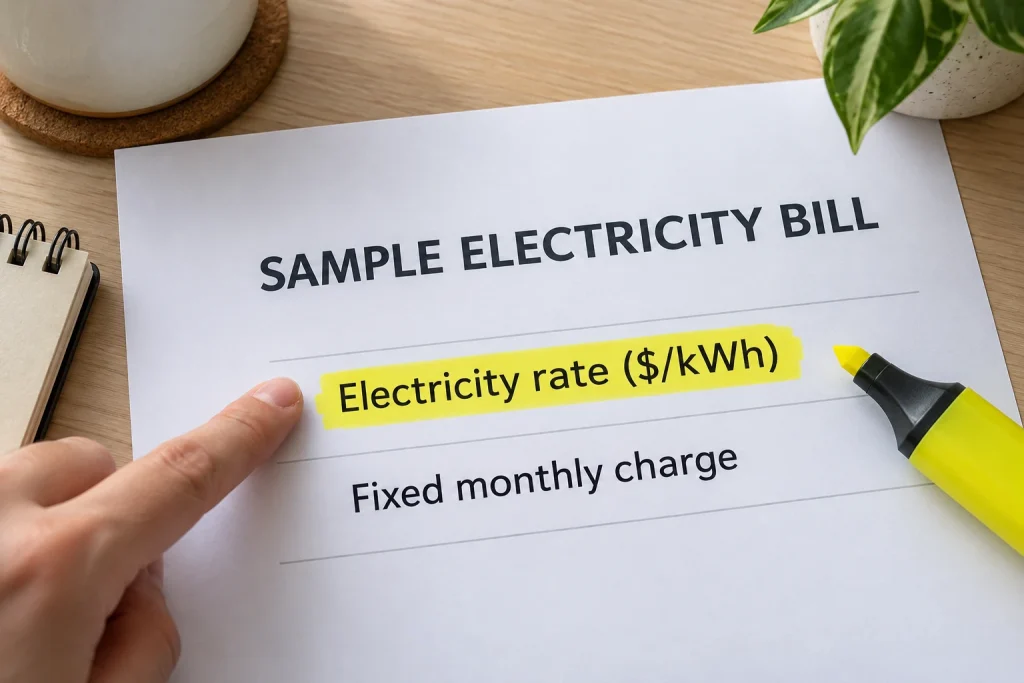
Enter your electricity price in dollars per kilowatt-hour, or $/kWh.
| Price shown on your bill | Calculator entry |
|---|---|
| 15 cents/kWh | 0.15 |
| 20 cents/kWh | 0.20 |
| 25 cents/kWh | 0.25 |
| 30 cents/kWh | 0.30 |
The calculator starts at $0.20/kWh as an example. Replace it with your own rate.
Include electricity supply and delivery charges that increase with each kWh used. Fixed monthly account fees are separate from the additional cost of running a heater.
If your electricity price changes by time of day, use a representative rate for the heating period. The calculator applies one rate to both routines, so it does not model separate peak and off-peak prices.
Enter Scheduled Hours and Use Days
Scheduled hours means the time the heater is switched on and available to heat during a typical use day.
Use days per month means the number of days you expect to follow that routine.
For example, a heater used during an eight-hour workday on 22 days per month would use:
- Scheduled hours: 8
- Use days: 22
Daily results describe a day when you use the heater, rather than an average across every calendar day.
Enter Your Active Heating Assumption
The active heating percentage describes how much of the scheduled time the heater draws the entered heating wattage.
| Assumption | Meaning during an eight-hour schedule |
|---|---|
| 100% actively heating | Eight active heating hours |
| 75% actively heating | Six active heating hours |
| 50% actively heating | Four active heating hours |
| 25% actively heating | Two active heating hours |
These percentages are scenarios to explore, not predictions about your room.
Start with 100% if you do not have a reasonable basis for estimating cycling. Then try a lower percentage to see how much the result depends on that assumption.
Before treating every shutdown as normal cycling, use our space heater shutdown troubleshooting guide to distinguish thermostat operation from timers and safety cutoffs.
Compare Routine B With Routine A
Change the second routine to answer a practical question, such as:
- Would a 500-watt personal heater used during work cost less than a 1,500-watt heater used for shorter sessions?
- What would changing from eight scheduled hours to four save?
- How much does using a heater on weekends add?
- How sensitive is the estimate to a different cycling assumption?
Change one input at a time when you want to understand what causes the difference.
Example: A 500-Watt Workday Heater vs. Shorter 1,500-Watt Sessions
This example uses $0.20/kWh, 22 use days per month, and continuous heating for both routines.
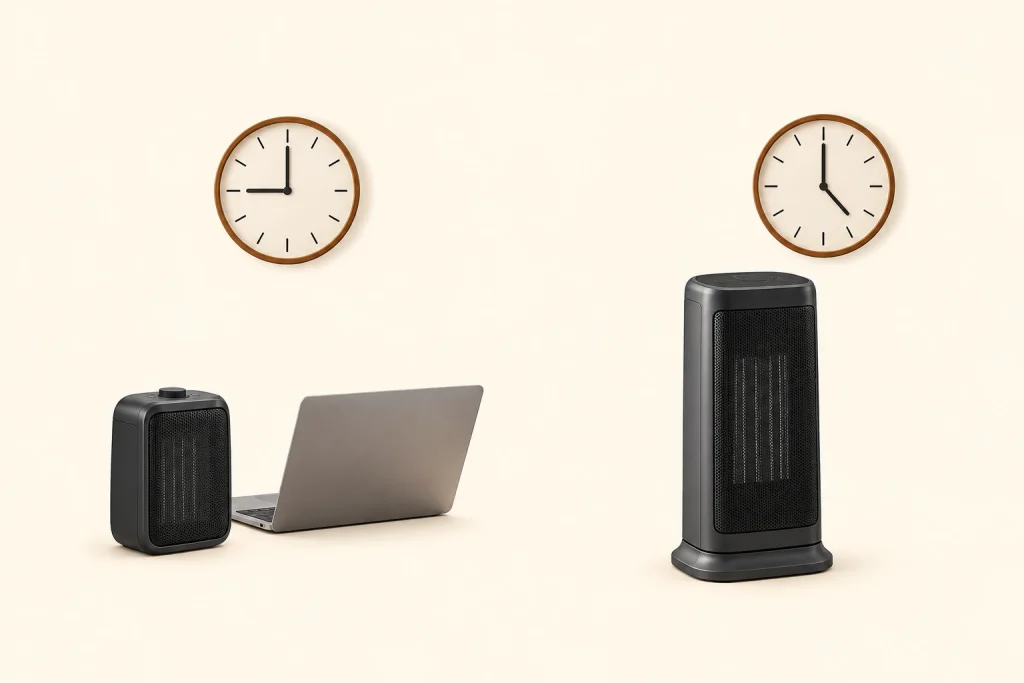
| Measure | Routine A: 500 watts for 8 hours | Routine B: 1,500 watts for 3 hours |
|---|---|---|
| Cost per active heating hour | $0.10 | $0.30 |
| Electricity per use day | 4 kWh | 4.5 kWh |
| Cost per use day | $0.80 | $0.90 |
| Monthly electricity | 88 kWh | 99 kWh |
| Monthly cost | $17.60 | $19.80 |
Routine A costs $2.20 less per month under these assumptions.
However, the two routines provide different heating patterns. A personal heater operating near your workspace for eight hours is a different comfort arrangement from three shorter hours of higher-output heating.
The calculator compares electricity use and cost. It does not establish which routine will keep you comfortable.
To compare actual low-wattage options for your workstation, see our guide to 200W, 400W and 500W personal heaters, covering controls, noise and heating limitations.
How Much Does a 1,500-Watt Heater Cost to Run?
A 1,500-watt heater draws 1.5 kilowatts while operating at that wattage.
Its cost per active heating hour is:
1.5 × your electricity price per kWh
| Electricity price | One active heating hour | Four active hours per day | Four active hours per day for 30 days |
|---|---|---|---|
| $0.15/kWh | $0.225 | $0.90 | $27.00 |
| $0.20/kWh | $0.30 | $1.20 | $36.00 |
| $0.25/kWh | $0.375 | $1.50 | $45.00 |
| $0.30/kWh | $0.45 | $1.80 | $54.00 |
These are calculated examples at continuous 1,500-watt draw during the stated active hours. They exclude off-cycle fan and standby electricity.
Scheduled Hours vs. Active Heating Hours
A heater can be switched on for eight hours without actively heating for all eight hours.
For example, an eight-hour schedule with a 50% active heating assumption represents four hours of heating at the entered wattage.
For a 1,500-watt heater at $0.20/kWh over 30 use days:
| Scenario | Active heating per use day | Estimated monthly cost |
|---|---|---|
| Eight scheduled hours at 100% heating | 8 hours | $72.00 |
| Eight scheduled hours at 50% heating | 4 hours | $36.00 |
The lower estimate depends entirely on the assumed cycling percentage. It is not a guaranteed saving from using a thermostat.
If your heater operates at several different power levels, a simple on/off percentage may not describe its electricity use accurately.

What Does the Continuous-Heating Maximum Mean?
The calculator’s maximum assumes the heater draws the entered wattage for every scheduled hour.
If you enter 750 watts, the maximum describes continuous operation at 750 watts. It does not automatically substitute the heater’s highest available setting.
Compare this figure with your cycling-based scenario to see how much your estimate relies on the heater spending time without actively heating.
The maximum covers the entered heating load. It is not a guaranteed ceiling for your entire electricity bill.
How Many Heating Hours Will Your Monthly Budget Cover?

Enter an optional monthly heater budget to calculate a cost-based allowance for each routine separately.
For example, a $30 monthly budget, a 1,500-watt heater, $0.20/kWh, and 30 use days gives:
$30 ÷ 30 days ÷ $0.30 per active hour = approximately 3.33 active heating hours per use day
At a 50% heating assumption, that corresponds to approximately 6.67 scheduled hours per day.
The scheduled-hours allowance depends on the cycling assumption. If the heater runs continuously instead, those 6.67 scheduled hours would exceed the budget.
Budget results are capped at 24 hours per day. They describe a spending calculation, not a recommendation for prolonged or unattended operation.
How the Calculator Works
The basic energy calculation converts watts to kilowatts and multiplies by operating time. Electricity cost then equals kWh multiplied by the electricity rate. Virginia Cooperative Extension uses this method for estimating appliance energy consumption and cost.
This calculator applies those formulas to each routine:
Active heating hours per use day = scheduled hours × active heating percentage ÷ 100
Daily electricity use = wattage ÷ 1,000 × active heating hours
Monthly electricity use = daily electricity use × use days per month
Electricity cost = electricity use in kWh × price per kWh
Monthly cost difference = Routine B monthly cost − Routine A monthly cost
Calculations use unrounded values before formatting the displayed results.
What the Calculator Cannot Tell You
The calculator does not predict:
- Room temperature or how quickly a room will warm.
- Thermostat cycling from room dimensions.
- Whether two routines provide comparable comfort.
- Fan noise, control clicks, or other operating sounds.
- Savings from reducing your central heating.
- Electrical circuit capacity or safe placement.
A cost estimate does not establish circuit suitability. If your space heater trips the breaker, review the shared-load and electrical-fault guidance before continuing use.
It also excludes off-cycle fan power and standby consumption. Those can make actual electricity use higher than the estimate when heating is inactive.
Unsure whether the wattage you entered can warm your room? Read What Size Space Heater Do I Need? for room-size estimates and heating limitations.
Equal electricity costs do not mean equal heating experiences. Our oil-filled vs. ceramic vs. infrared heater comparison explains the differences in sound, warm-up, and heat delivery.
If you are choosing a heater for its sound and heating approach, see our quiet space heaters for bedrooms guide.
Space Heater Safety Comes Before Cost Savings
Keep portable heaters at least three feet from bedding, curtains, furniture, and other combustible materials. Plug electric space heaters directly into a wall outlet, and turn them off before sleeping. CPSC advises against using extension cords or power strips for electric space heaters.
Follow the heater’s instructions and required clearances. A favorable cost estimate does not make a heating routine safe.
Frequently Asked Questions
Does a 1,500-Watt Heater Use 1.5 kWh Every Hour?
It uses 1.5 kWh during an hour in which it continuously draws 1,500 watts. An hour with heating interruptions or lower-power operation can use less.
Is a 500-Watt Heater Always Cheaper Than a 1,500-Watt Heater?
Its cost per active heating hour is lower at the same electricity rate. Total cost also depends on operating time.
At continuous draw, a 500-watt heater used for three hours consumes the same electricity as a 1,500-watt heater used for one hour: 1.5 kWh.
Does 50% Thermostat Cycling Mean Half the Electricity Cost?
In this calculator, 50% actively heating means half the entered heating energy and cost compared with continuous operation during the same schedule.
Actual consumption may also include fan or standby power, and the heater may change wattage while heating.
Can I Use the Calculator for an Oil-Filled Radiator?
Yes. Enter the wattage at the selected setting and your active heating assumption.
Heat released after the element switches off does not require another entry for that stored heat. Electricity was consumed while the element heated the radiator.
Still choosing a model? Compare the heat settings and controls in our guide to the best quiet oil-filled radiator heaters, then use your selected model’s wattage in the calculator.
Can This Calculator Compare a Space Heater With a Heat Pump?
It can calculate cost from an entered electrical wattage, but it does not compare useful heat delivered by different heating systems. Use a heating-system comparison that accounts for heat output, efficiency, weather, and the area being heated.
Are My Inputs Saved?
No. The calculator runs in your browser and does not save your entries. Reloading the page restores the example values.