Oil-Filled vs. Ceramic vs. Infrared Heaters: Noise, Warm-Up & Running Cost
Researched and reviewed by Dustin Sosko
Published: October 11, 2026
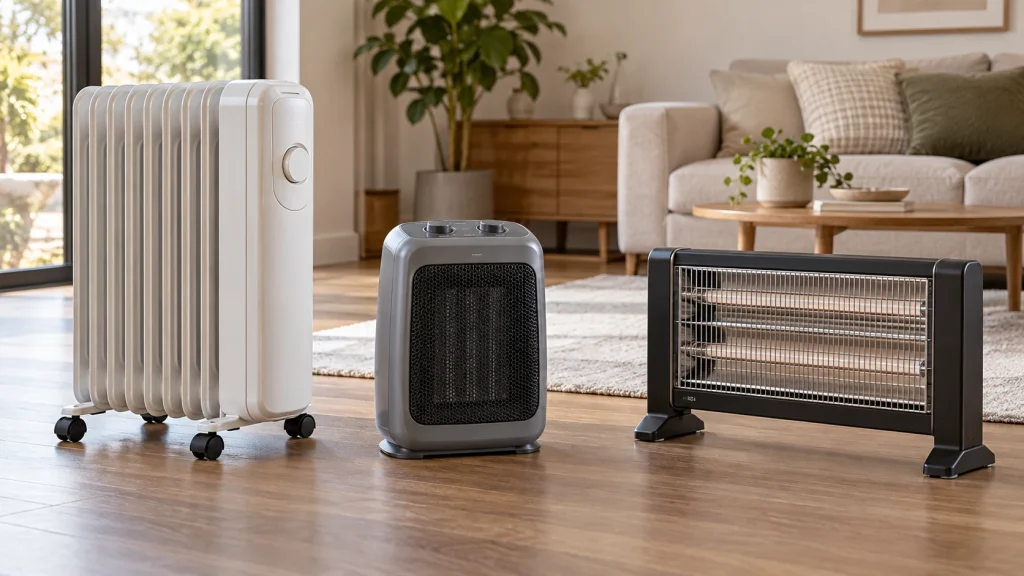
Comparing oil filled vs ceramic vs infrared heaters comes down to how quickly you want warmth, how much operating noise you can tolerate, and whether you need directed personal warmth or room heating.
The differences affect how warmth reaches you, how quickly it feels comfortable, and what you hear. Running cost depends on the electricity consumed. At the same actual power draw and operating time, these electric heater types cost the same to run.
This guide compares their noise sources, warm-up behavior, and electricity costs so you can choose a design that fits your room and routine. For the rest of the cluster, visit our quiet space heater guides and calculators.
Quick Answer: Which Heater Type Should You Choose?
Choose a fanless oil-filled radiator when avoiding continuous fan sound matters most and you can wait for gradual warmth. It suits longer, supervised heating sessions where you value a steady release of heat.
Choose a ceramic fan heater when you want warm airflow quickly and can tolerate a fan. It can be useful when entering a cold home office or adding warmth during a shorter session.
Choose a fanless infrared heater when you want directed warmth while sitting in a suitable position near the heater. The location and direction of the heater matter because radiant warmth depends on what its heat reaches.
Check infrared cabinet heaters separately. Some combine infrared elements, ceramic heating, and a blower. They should not be assumed to offer the same noise or heat delivery as a fanless radiant heater. Manufacturer documentation for the Dr. Infrared DR-968, for example, describes a combined quartz and PTC heating system with airflow.
Oil Filled vs Ceramic vs Infrared: Comparison Table
The ceramic column below refers to common portable ceramic fan heaters. The infrared column refers to fanless radiant designs; blower-equipped infrared cabinet heaters behave differently.
| Feature | Fanless oil-filled radiator | Ceramic fan heater | Fanless infrared heater |
|---|---|---|---|
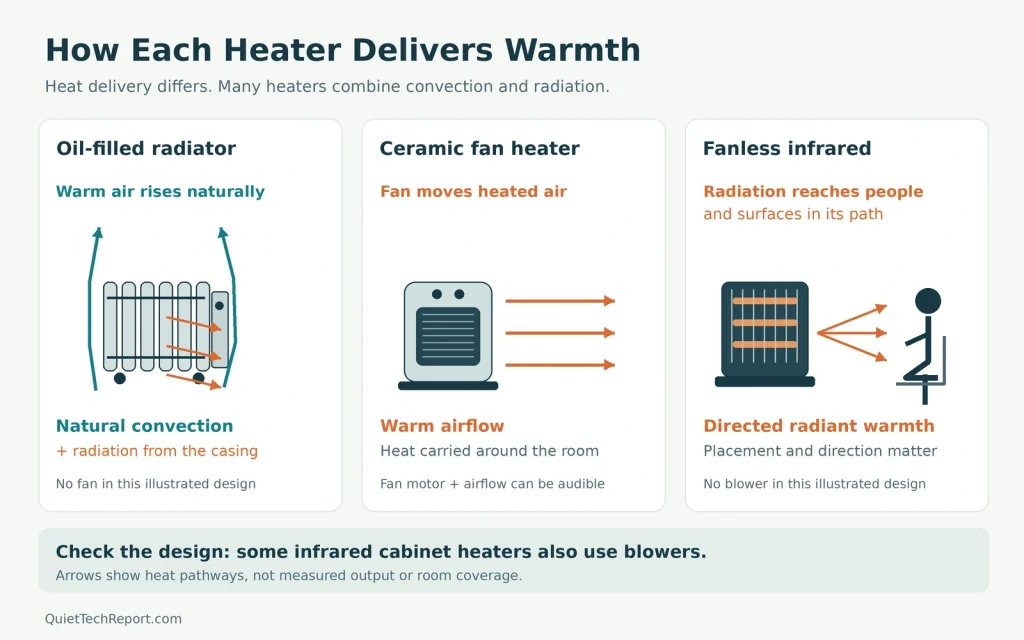
| Main heat delivery | Natural convection and radiation from the heated casing | Warm air moved by a fan | Radiant heat directed toward people and surfaces |
| Initial experience | Gradual warmth as the oil and casing heat | Warm airflow becomes available quickly | Direct warmth develops as the emitter heats; speed varies by design |
| Continuous fan noise | None | Present while the fan runs | None |
| Other possible sounds | Clicks, ticks, crackles, or timer sounds | Beeps, clicks, oscillation sounds, and rattles | Clicks, expansion sounds, or control beeps |
| Heating someone nearby | Less focused warmth | Directed warm airflow | Directed radiant warmth |
| Room-heating behavior | Gradual air circulation | Fan distributes heated air | Depends strongly on design, placement, and room conditions |
| After switch-off | Stored heat releases gradually | Active warm airflow ends; limited residual heat remains | Direct warmth declines as the emitter cools |
| Cost at equal actual wattage and operating time | Equal | Equal | Equal |
Oil-filled heaters use sealed oil to transfer heat through the appliance, while fan heaters move heated air. Radiant heaters can be useful where direct personal warmth is the priority. These are differences in delivery rather than a universal electricity-efficiency ranking.
Which Heater Type Is Quietest?
For someone sensitive to a constant hum or rushing-air sound, fanless construction is usually the most useful starting point.
A fanless heater removes the fan motor and airflow as continuous noise sources. However, it may still make intermittent sounds that stand out in a quiet room.
Oil-Filled Radiator Noise
A fanless oil-filled radiator does not need a blower to circulate warmth. Heated air rises naturally around the casing.
Depending on the model, you may hear thermostat or relay clicks, sounds during warm-up and cooling, or a mechanical timer. De’Longhi also documents crackling that can occur during use, which is why “fanless” is a more accurate description than a promise of complete silence.
Check the specific radiator’s construction. Some oil-filled models include a fan or boost function, so the category name alone does not guarantee fanless operation.
Ceramic Heater Noise
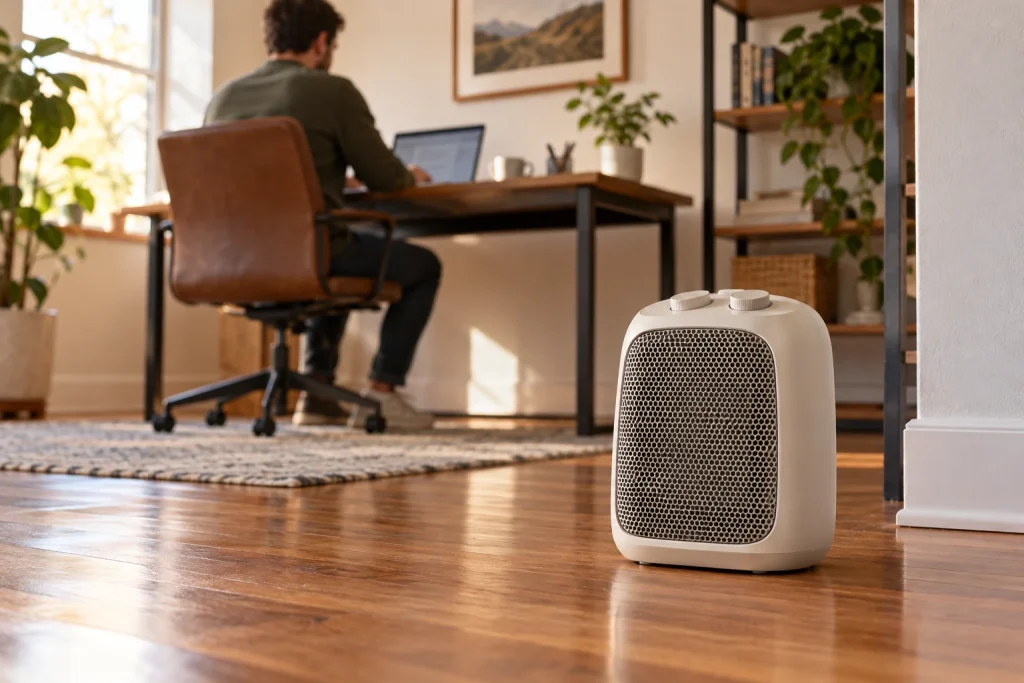
A ceramic fan heater produces sound from its motor and the movement of air through the heater.
A low heat setting does not necessarily mean a slower or quieter fan. Some models change heating power while keeping similar airflow; others adjust both. Check the operating modes rather than assuming that “low,” “ECO,” and “quiet” mean the same thing.
Oscillation, button beeps, and a fan that continues briefly after heating stops can also affect how disruptive the heater feels.
Infrared Heater Noise
Fanless radiant infrared heaters avoid continuous fan sound, but some infrared cabinet heaters have blowers.
Before choosing one for a quiet workspace, check:
- Whether the heater contains a fan or blower.
- Whether the fan runs whenever heating is active.
- Whether controls beep and whether those sounds can be muted.
- Whether any published sound rating identifies the operating mode and measurement distance.
A manufacturer’s decibel claim can help describe a particular model, but figures measured under different conditions are not a controlled comparison.
Compare the Sound You Will Actually Notice
| If this sound bothers you… | Prioritize this feature |
|---|---|
| Constant fan hum | Fanless construction |
| Rushing air | Natural convection or fanless radiant heating |
| Sudden clicks | Model-specific evidence about thermostat and relay behavior |
| Button beeps | A documented mute function |
| Oscillation sounds | A stationary design or the ability to disable oscillation |
| Mechanical timer ticking | Electronic controls without a mechanical timer |
If you already own a heater and its sound has changed, use our space heater noise troubleshooting guide to distinguish expected operating sounds from symptoms requiring attention.
Which Warms You Up Fastest—and Which Warms the Room?
Feeling warmth nearby and raising the room’s air temperature are different outcomes.
A heater can make you feel warmer while a thermometer across the room shows little change. Conversely, a radiator can gradually improve room temperature without producing an obvious stream of hot air.
Before comparing heat delivery, check how much heater wattage your room needs. Choosing a different heater type does not remove the need for sufficient heating capacity.
Ceramic Heaters: Quick Warm Airflow
Ceramic fan heaters can provide warm airflow shortly after starting. The fan also helps move that heated air beyond the appliance.
This can suit someone entering a cold office who wants warmth promptly. However, warm air coming from the heater does not establish how quickly the entire room will reach a target temperature.
That depends on heating output, starting temperature, insulation, drafts, ceiling height, and heat escaping through walls and windows.
For a smaller personal-heating task, compare low-wattage ceramic desk heaters with 200W, 400W and 500W output, keeping their fan noise and whole-room heating limits in mind.
Oil-Filled Radiators: Gradual Warmth
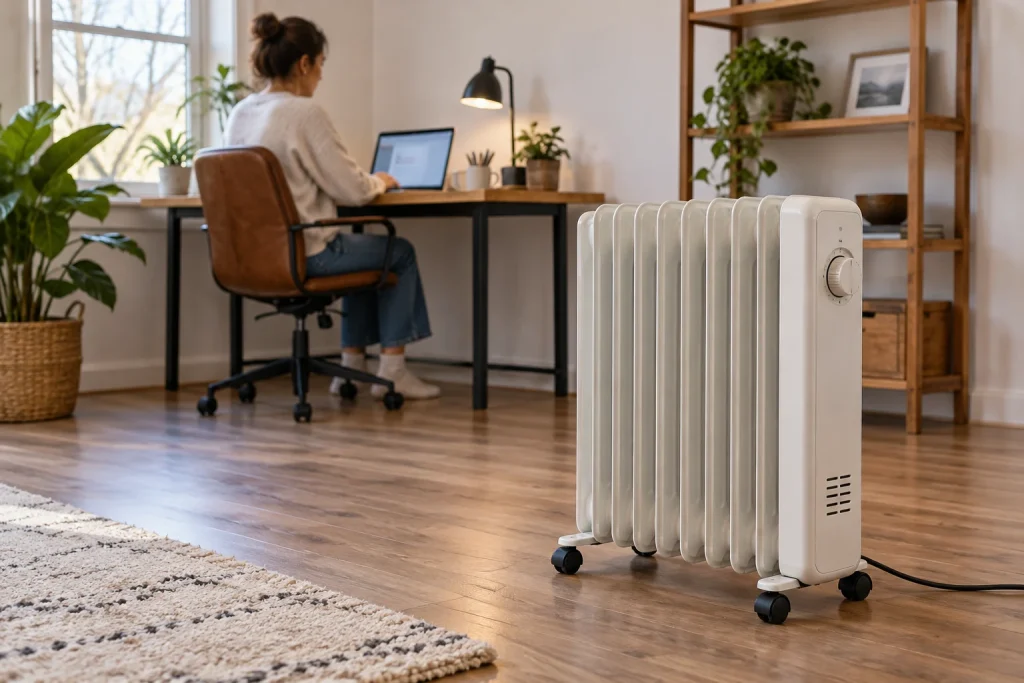
An oil-filled radiator must heat its internal oil and casing before delivering substantial warmth to the surrounding space.
De’Longhi describes a gradual convection cycle and notes that these heaters do not immediately warm an area. Their response depends partly on room size, and they retain heat after switch-off.
This slower response can be acceptable during a longer session. It is less convenient when you need a brief burst of warmth immediately.
Infrared Heaters: Directed Warmth, With Important Variations
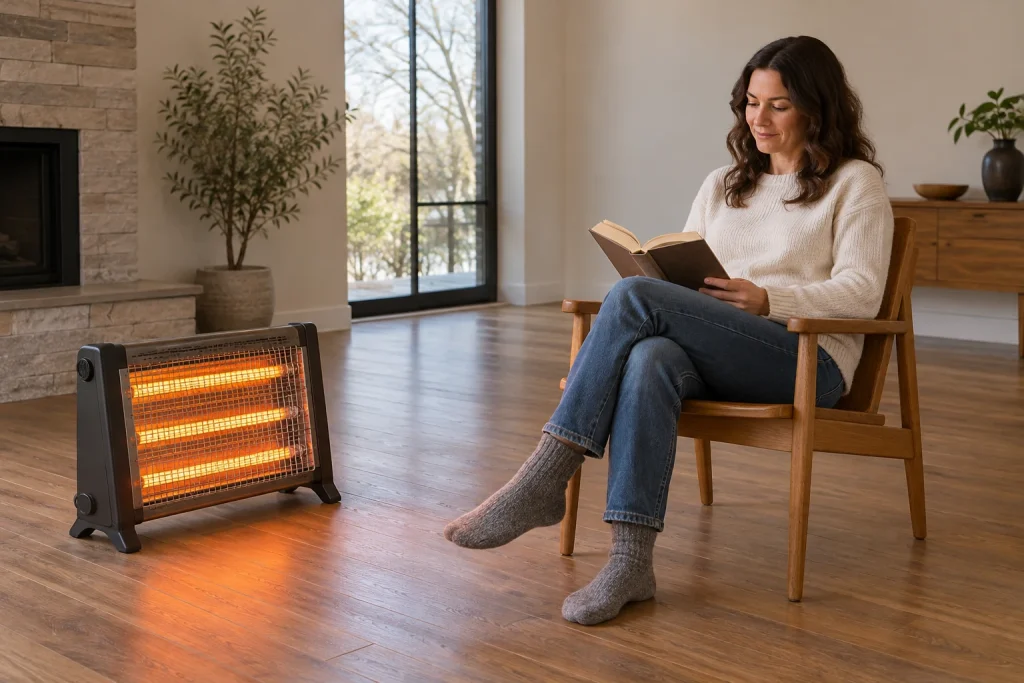
A fanless radiant heater can warm a person or surface within its effective path without first needing to raise all the room air to the same temperature.
Position matters. Moving away, turning away, or placing an obstruction between you and the heater can change the warmth you experience.
Do not assume every infrared heater responds instantly. Quartz-style radiant heaters, larger infrared panels, and cabinet heaters with blowers have different construction and warm-up behavior.
Why There Is No Reliable Universal Warm-Up Time
Claims such as “ceramic warms a room in 10 minutes” or “oil-filled takes 30 minutes” are incomplete without a defined room, starting temperature, target temperature, and heater setting.
For a useful measured comparison, all heaters would need comparable starting conditions and the same room-temperature measurement locations.
Without that evidence, compare quick warm airflow, gradual warmth, and directed radiant warmth rather than treating unsupported minute counts as specifications.
Which Heater Costs Less to Run?
At equal actual electrical input and operating time, oil-filled, ceramic, and infrared resistance heaters have the same electricity cost.
Electric resistance heating converts essentially all electricity consumed into heat at the point of use. A different heating element or heat-delivery method does not automatically reduce the electricity required for a given amount of heat. Changing heater type also does not automatically reduce circuit demand: our guide to space heater breaker trips explains why a 1,500-watt oil-filled, ceramic, or infrared heater can present a similar electrical load.
Same Watts, Same Continuous-Running Cost
Using an example electricity rate of $0.20 per kilowatt-hour:
| Heater type | Actual power draw | Electricity used in one continuous hour | Cost |
|---|---|---|---|
| Oil-filled | 1,500W | 1.5kWh | $0.30 |
| Ceramic | 1,500W | 1.5kWh | $0.30 |
| Infrared | 1,500W | 1.5kWh | $0.30 |
Calculation: 1.5kW × 1 hour × $0.20/kWh = $0.30.
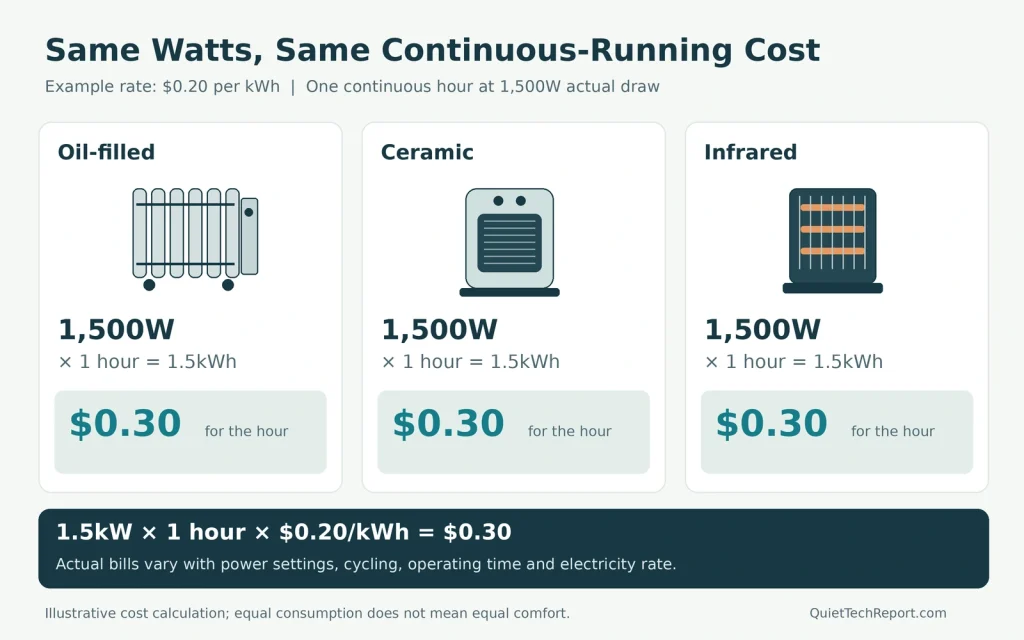
The $0.20 rate is illustrative. Use the usage-based electricity price on your own bill.
Also distinguish the maximum rating from actual operation. A heater labeled 1,500W may use a lower setting, switch its element off periodically, or change power automatically.
Why Real Electricity Bills Can Differ
Two heaters with the same maximum wattage may consume different amounts of electricity during a session because they operate differently.
| Factor | Why it changes electricity use |
|---|---|
| Selected power setting | Lower actual wattage reduces consumption per operating hour |
| Session length | More operating time increases total consumption |
| Thermostat cycling | The heating element may operate for only part of the session |
| Automatic power changes | Some modes alternate between different heating levels |
| Requested temperature | A higher target can require more heating |
| Room heat loss | Drafts and poor insulation can increase demand |
| Heating task | Warming one person may allow a different routine from heating an entire room |
A fanless infrared heater might let a seated person feel comfortable while keeping the surrounding room cooler. That could save electricity if it reduces total consumption. It is not a guaranteed saving attached to the infrared label.
Similarly, a lower-wattage heater costs less per continuous operating hour, but it may run longer or fail to provide enough warmth for the task.
Use our space heater electricity cost calculator to compare wattages, schedules, and your own assumptions about thermostat cycling.
Does an Oil-Filled Heater Save Money After You Turn It Off?
An oil-filled radiator continues releasing warmth after switch-off because its oil and metal casing stored heat while the element was operating.
That warmth was paid for during the earlier heating period.
Thermal storage changes when heat reaches the room. It does not create additional energy or establish that an oil-filled radiator is cheaper than another heater delivering comparable comfort.
The gradual release may feel pleasant during thermostat cycles or after a supervised session ends. However, it also makes the heater less responsive when you want heating to stop quickly.
Compare total electricity consumed across a complete session rather than judging efficiency only by whether the casing remains warm after switch-off.
Choose a Heater for Your Room and Routine
| Your situation | Design to consider first | Main tradeoff |
|---|---|---|
| You dislike steady fan sound during a long work session | Fanless oil-filled radiator | Slower initial warmth |
| You enter a cold room and want warm airflow promptly | Ceramic fan heater | Continuous fan sound |
| You stay in one chair and want directed personal warmth | Fanless radiant infrared heater | Position and heat direction matter |
| You move around and want warmth distributed through the room | A suitable convection or fan-assisted heater | Room heat loss and available output still control performance |
| You want quieter supervised bedroom heating before sleep | A fanless design | Turn portable heaters off before sleeping |
| You want the lowest electricity bill | Compare the complete heating routine | No heater type is universally cheapest |
For model recommendations and room-specific considerations, see our quiet space heaters for bedrooms and nursery safety guide.
Safety Differences and Placement
Do not choose a heater solely because one technology sounds safer.
Surface temperatures, stability, guards, controls, clearances, and permitted locations vary by model. An enclosed element does not mean the casing cannot burn someone, and a “cool-touch” description should not be assumed to apply to every surface.
Current CPSC guidance advises keeping portable heaters at least three feet from combustible materials, plugging electric heaters directly into a wall outlet, and turning them off when sleeping.
For all three types:
- Follow the manufacturer’s placement instructions and any larger required clearances.
- Keep bedding, curtains, furniture, clothing, and other combustible items away.
- Keep the heater stable and protect it from being knocked over.
- Keep children and pets away from hot surfaces.
- Use the heater only in locations approved by its instructions.
- Stop using it if there is damage, smoke, sparking, or other signs of an electrical problem.
Tip-over protection, overheat protection, timers, and thermostats are useful features. They do not replace suitable placement and supervision.
If a heater shuts off during use, our shutdown diagnostic guide helps separate normal thermostat cycling and timer settings from tip-over protection and overheating.
Frequently Asked Questions
Oil Filled vs Ceramic: Which Heater Costs Less to Run?
Not automatically. At equal actual wattage and operating time, their electricity costs are equal. Differences in power settings, thermostat behavior, room conditions, and usage can change total consumption.
Is an infrared heater quieter than a ceramic heater?
A fanless infrared heater avoids the fan sound produced by a ceramic fan heater. An infrared cabinet heater with a blower may still produce continuous airflow noise. Check the specific construction.
Does an oil-filled heater use oil as fuel?
No. In a conventional electric oil-filled radiator, the oil is sealed inside and transfers heat. It is not burned as fuel or routinely consumed.
Does a ceramic heater warm the whole room faster?
Its fan provides quick warm airflow and helps distribute heated air. A specific room-temperature advantage requires comparable testing; it cannot be guaranteed from the ceramic label alone.
Does an infrared heater heat only people?
No. Radiant heat can warm people and surfaces that absorb it. Those warmed surfaces can subsequently transfer heat to surrounding air. Direct personal warmth is one use, rather than the only effect.
Is a fanless heater completely silent?
Not necessarily. Removing the fan eliminates a major continuous sound source, but controls, thermostats, timers, and warm-up or cooling behavior may still produce audible sounds.
Can I leave an oil-filled heater running while I sleep?
CPSC advises turning portable heaters off when sleeping. Fanless operation and stored warmth do not change that guidance.
Sources and Research Method
This comparison is based on government energy guidance and manufacturer documentation checked October 11, 2026. It explains heater designs and operating principles; it does not present hands-on noise measurements or controlled warm-up tests.
The running-cost examples are calculated from the stated wattage, operating time, and illustrative electricity rate. They are not measured product consumption.
Key sources:
- Australian Government energy guidance on resistance heating, oil-filled heaters, fan heaters, and radiant heating.
- De’Longhi documentation on oil-filled radiator operation, gradual warm-up, retained warmth, and operating sounds.
- Lasko documentation illustrating ceramic heating with directed airflow.
- Dr. Infrared documentation illustrating a combined infrared and PTC design with airflow.
- U.S. Consumer Product Safety Commission guidance on portable-heater placement, electrical connections, and use during sleep.