What Size Space Heater Do I Need? Room Size, Wattage & Heating Limits
Researched and reviewed by Dustin Sosko
Published: October 11, 2026
What size space heater do I need? Start by measuring your room and allowing approximately 10 watts per square foot as a rough estimate. Using that rule, a 100-square-foot room corresponds to about 1,000 watts, while a 150-square-foot room corresponds to about 1,500 watts. Manufacturer guidance treats this as a starting point, with a heat-loss calculation needed for greater accuracy.
The important qualification is that floor area does not tell you how quickly a room loses heat. A small, drafty bedroom can be harder to warm than a larger room with good insulation and existing central heating.
Before choosing a heater, determine whether you need to heat the entire room, supplement your main heating system, or simply feel warmer while sitting at a desk.
How to Measure Your Room for a Space Heater
Measure the room’s length and width in feet, then multiply them:
Room area in square feet = length × width
For example:
10 feet × 12 feet = 120 square feet
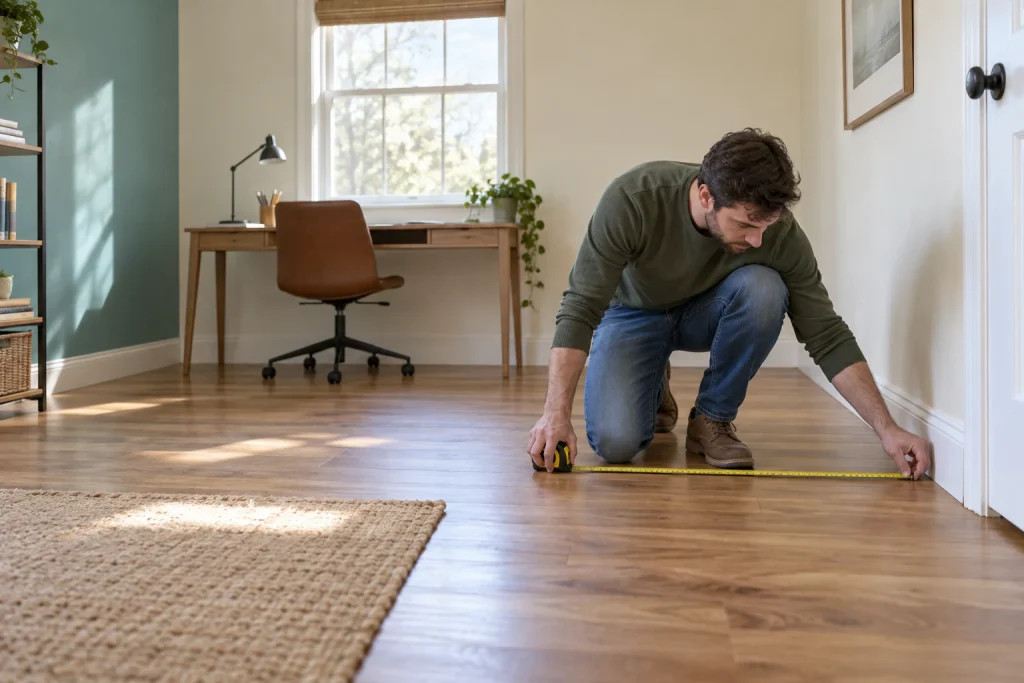
For an L-shaped room, divide the floor into rectangles, calculate each area, and add them together.
Measure the space you expect to warm during normal use. If your living room opens directly into a kitchen and hallway, warmth can spread beyond the living room’s footprint. Treating that room as an enclosed space can make a heater seem more capable than it will be in practice.
You do not need to subtract beds, sofas, or desks from the floor area. Furniture also affects airflow and placement, so a tightly furnished room may provide fewer suitable locations for a heater.
Space Heater Wattage by Room Size
The following table uses 10 watts per square foot. These are calculated starting estimates, not tested coverage ratings or guarantees.
| Room dimensions | Floor area | Starting wattage estimate |
|---|---|---|
| 8 × 10 feet | 80 sq ft | 800 watts |
| 10 × 10 feet | 100 sq ft | 1,000 watts |
| 10 × 12 feet | 120 sq ft | 1,200 watts |
| 10 × 15 feet | 150 sq ft | 1,500 watts |
| 12 × 15 feet | 180 sq ft | 1,800 watts |
| 10 × 20 feet | 200 sq ft | 2,000 watts |
| 15 × 20 feet | 300 sq ft | 3,000 watts |
| 20 × 20 feet | 400 sq ft | 4,000 watts |
For a quick calculation:
Starting wattage estimate = room area × 10
A 120-square-foot room therefore produces a starting estimate of:
120 × 10 = 1,200 watts
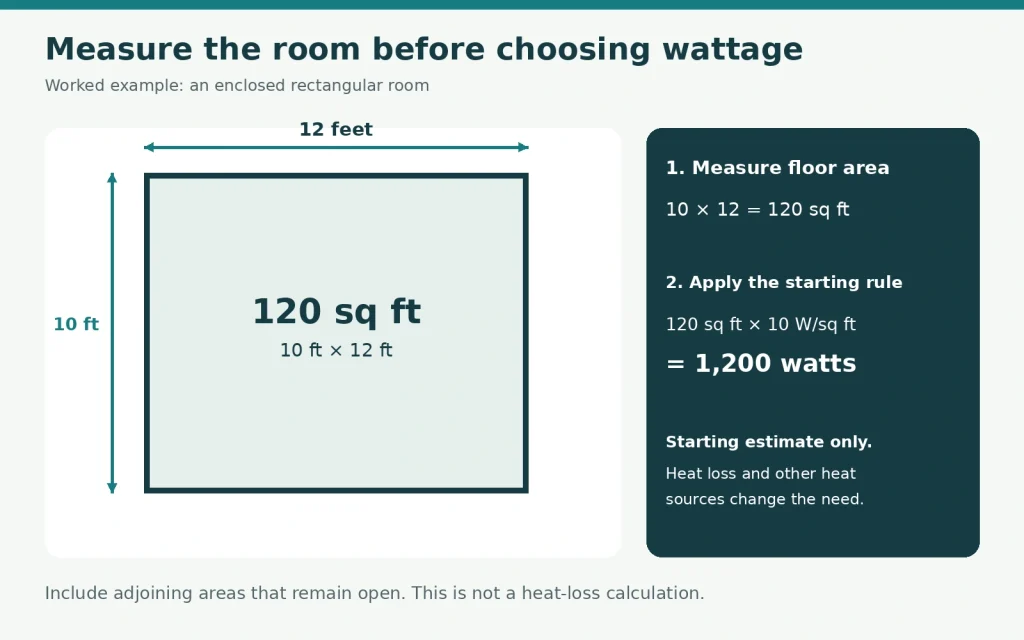
That number is a planning reference. It does not mean you must find a heater with exactly that rating.
A heater with selectable settings and a thermostat can adjust its operation as conditions change. Check the actual wattage of each setting: “low” and “high” do not represent the same wattages on every model.
How Big a Room Can a 1,500-Watt Heater Heat?
A 1,500-watt heater corresponds to approximately 150 square feet under the 10-watts-per-square-foot rule. That figure is a useful reference rather than a universal maximum.
Vornado also uses approximately 10 watts per square foot as a guide for portable heaters, with most of its units operating at up to 1,500 watts.
A heater may provide useful warmth beyond that reference area when another heating system already supplies much of the room’s heat. Conversely, it may struggle in a smaller room with significant drafts or cold exterior surfaces.
When evaluating an advertised coverage figure, ask:
- Does it describe supplemental heating or the room’s only heat source?
- What insulation and outdoor conditions does it assume?
- Is it describing whole-room temperature or warmth near the heater?
- Does the manufacturer explain the conditions behind the claim?
A coverage figure without those details cannot tell you whether the heater will maintain your desired temperature.
Is 1,500 Watts Enough for a 200-Square-Foot Room?
It can be enough to provide supplemental warmth, but you should not assume it can supply all the room’s heating needs.
For example, consider a hypothetical room requiring 2,000 watts of heat under particular winter conditions. If central heating already supplies 1,200 watts, the remaining shortfall is 800 watts. A 1,500-watt portable heater has enough nominal output to cover that shortfall.
If the same room receives no other heat, the portable heater falls below the assumed requirement.
This example illustrates the difference between total heating demand and supplemental demand. It is not a measurement of a particular room.
Can a 1,500-Watt Heater Warm 300–400 Square Feet?
It may improve comfort in a larger room, particularly alongside existing heating. However, being able to add warmth does not establish that it can maintain the entire space at your target temperature.
For a large room, pay particular attention to open doorways, uneven temperatures, and how much heat the existing system provides.
Are You Heating the Room or Just Yourself?
These three goals require different decisions.
| Heating goal | What matters most | What to expect |
|---|---|---|
| Heat an enclosed room without another heat source | Room heat loss and heater output | The heater must meet the room’s full heating demand |
| Supplement central heating | The remaining heating shortfall | A portable heater may help in a room larger than a simple sizing estimate suggests |
| Feel warmer at a desk or chair | Placement and how heat reaches you | Local comfort can improve while much of the room remains cooler |
A personal heater that makes your feet feel warm has not necessarily heated the entire office. Likewise, a room heater can produce enough total heat but distribute it unevenly.
Decide which outcome matters before comparing wattage or coverage claims.
If your goal is supplemental warmth at one desk or chair, compare our low-wattage space heaters for personal heating, including their limits on whole-room heating.
Why Two Rooms of the Same Size Can Need Different Heaters
Professional residential load calculations account for building characteristics and design conditions, including windows, air infiltration, and other sources of heat loss. That is why square footage alone cannot provide a precise heating requirement.
Use the following conditions to judge how dependable a basic floor-area estimate is.
| Room condition | What it means for sizing |
|---|---|
| Noticeable drafts around windows or doors | Warm air escapes and colder air enters |
| Large areas of exterior glass | Window performance becomes especially important |
| Several exterior walls | More surfaces separate the room from outdoor conditions |
| High or vaulted ceilings | Floor area alone describes the space less completely |
| Open connection to other rooms | Heat spreads beyond the area you measured |
| Much colder outdoor weather | Maintaining the same indoor temperature becomes more demanding |
| Existing central heating | The portable heater may only need to supply additional heat |
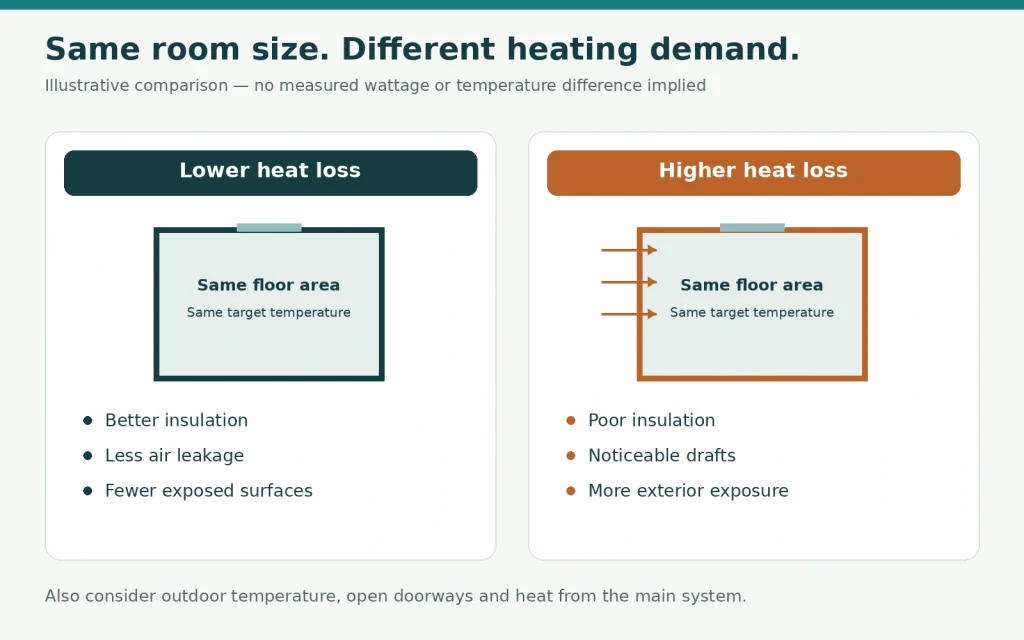
Insulation and Air Leakage
Insulation slows heat transfer through the building, while air sealing reduces uncontrolled air movement.
A heater cannot compensate indefinitely for a room that loses heat faster than the heater supplies it. Addressing an obvious draft may improve comfort more than changing between two heaters with the same maximum wattage.
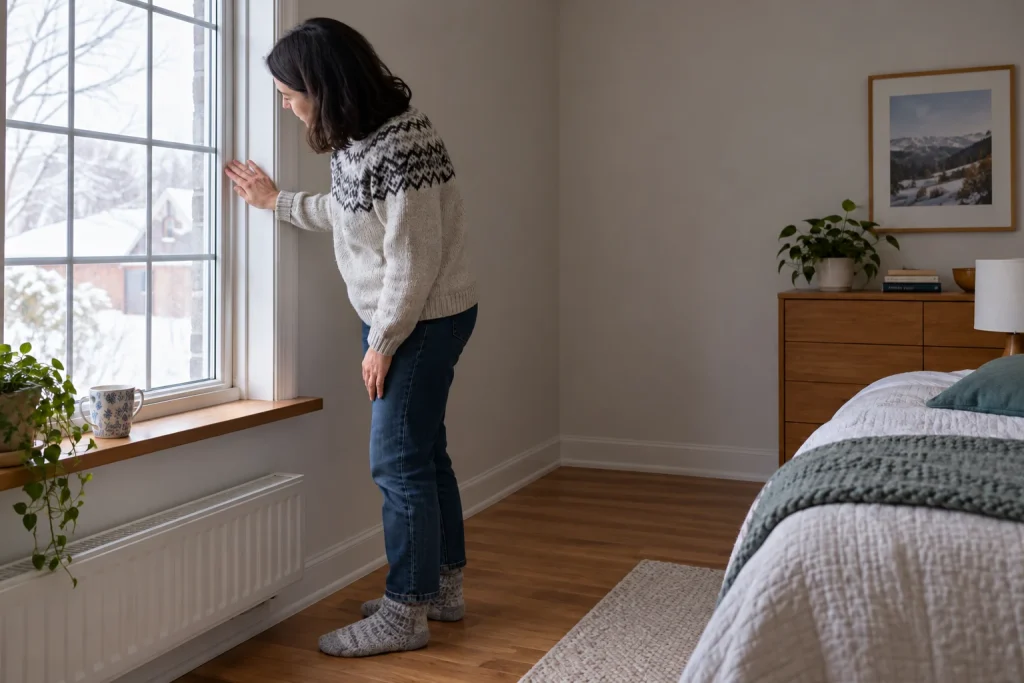
Keep heater intakes, outlets, and required clearances unobstructed when rearranging furniture or making draft improvements.
Outdoor Temperature
The same heater can perform differently as the weather changes.
A room that stays comfortable during mild weather may become difficult to heat during a cold spell. Your indoor target matters too: maintaining a warmer room generally requires more heat under otherwise similar conditions.
High Ceilings and Open Layouts
A tall ceiling adds room volume and changes the surfaces and air movement involved in heating. An open layout allows warmth to move into adjoining areas.
Neither condition can be accurately corrected with a universal percentage. If a room has vaulted ceilings or extensive openings, treat a floor-area estimate with greater caution.
Does Heater Type Change Heating Capacity?
For electric resistance heaters, equal electrical wattage produces essentially equal total heat output. Dimplex makes this distinction in its technical guidance.
The differences you feel involve how heat reaches you, how quickly the heater responds, and how it controls temperature.
Fan-Forced and Ceramic Heaters
A fan moves warmed air away from the heater. This can make warmth noticeable quickly and help distribute it, although the fan also adds operating sound.
Air movement improves distribution; it does not turn a 1,500-watt heater into a higher-output heater.
Oil-Filled Radiators
Oil-filled radiators typically operate without a fan. Their heated surfaces transfer warmth to the room through radiation and natural convection.
They take time to warm and can continue releasing stored heat after the heating element switches off. That stored warmth came from electricity consumed earlier.
Infrared and Radiant Heaters
Radiant heaters can make a person feel warmer through direct exposure. This is useful when personal warmth is the goal.
Feeling warmer in front of the heater does not demonstrate that distant parts of the room have reached the same temperature.
For lower-noise options and practical buying considerations, see our guide to quiet space heaters for bedrooms and nurseries.
What If Your Room Needs More Than 1,500 Watts?
Many conventional 120-volt portable heaters are limited to approximately 1,500 watts or less. A higher calculated heating requirement therefore deserves a closer look before buying a typical plug-in model.
Start with these steps:
- Confirm your heating goal. Determine whether the heater needs to supply all the heat or supplement an existing system.
- Check the measured area. Include connected spaces that remain open.
- Address obvious heat loss. Investigate drafts and poorly performing windows.
- Check the main heating system. A persistently cold room may have a distribution or maintenance problem.
- Consider a room-specific assessment. An HVAC professional can assess heating demand; an electrician can assess requirements for installed electric heating.
Do not automatically solve an estimated shortfall by adding another portable heater.
Two outlets do not necessarily mean two separate circuits. At a nominal 120 volts, a 1,500-watt heater draws approximately 12.5 amps:
Amps = watts ÷ volts
1,500 ÷ 120 = 12.5 amps
Other equipment sharing that circuit contributes to its load. Two 1,500-watt heaters would draw approximately 25 amps together, exceeding the rating of a typical 15- or 20-amp household circuit.
Do not repeatedly reset a breaker that trips when a heater operates. Have the cause assessed. Our guide to why a space heater trips the breaker explains how shared outlets and combined electrical loads affect the circuit, and when further investigation is needed.
How to Tell Whether Your Heater Is Keeping Up
Observe the room during supervised use rather than relying only on the temperature displayed on the heater.
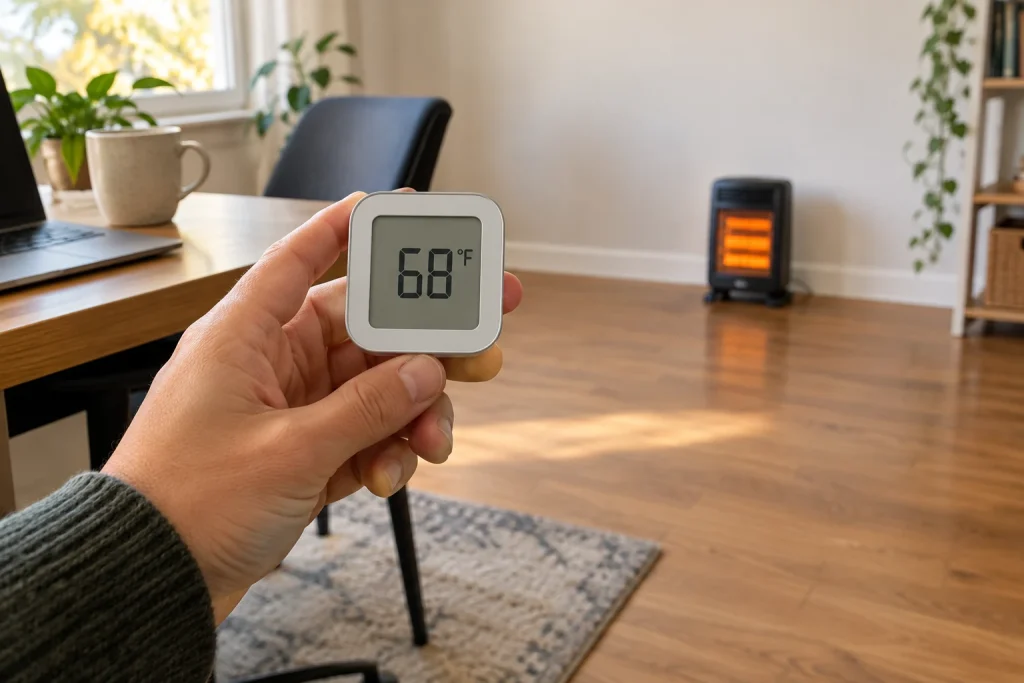
Place a separate room thermometer away from the heater’s direct airflow, strong sunlight, and an exterior window. Record the starting temperature, outdoor conditions, selected setting, and whether doors are open.
| What you observe | What it may indicate |
|---|---|
| The room reaches the target and the heater cycles | Output is sufficient under those observed conditions |
| The heater operates continuously and temperature keeps rising | The room is still warming |
| The heater operates continuously but temperature levels off below the target | Available heat may be insufficient, or controls and placement may need checking |
| The heater stops while distant parts of the room remain cold | Uneven distribution or the sensor’s location may be affecting control |
| Comfort deteriorates when outdoor temperatures fall | Heating demand has increased |
| The breaker trips or a plug/outlet becomes excessively hot | Stop using the setup and have the electrical problem assessed |
These observations are clues, not a substitute for troubleshooting instructions.
If the heater stops before the room feels comfortable, learn why your space heater keeps shutting off before assuming you need a higher-wattage model.
There is no universal warm-up time. Walls, furniture, starting temperature, heat loss, and heater operation all affect how quickly the room becomes comfortable.
Space Heater Placement and Safety Limits
Sizing does not override safe placement.
The U.S. Consumer Product Safety Commission recommends keeping portable heaters at least three feet from furniture, bedding, drapes, and other combustible materials; plugging electric heaters directly into wall outlets; and turning them off when sleeping.
Also follow the heater’s instructions for placement, clearances, and permitted environments. A model’s quiet setting, thermostat, or timer does not establish that it is safe to leave running overnight.
If a room cannot accommodate the required clearances near a suitable outlet, choose a different heating arrangement.
Frequently Asked Questions
What Size Space Heater Do I Need for a Bedroom?
Measure the bedroom first, then consider its drafts, exterior walls, windows, and existing heating.
A 10 × 12-foot bedroom measures 120 square feet. The basic sizing calculation gives a 1,200-watt starting estimate, but the room’s actual heating requirement can differ.
Use portable heating while awake and supervising it, and turn the heater off before sleeping.
Is a 750-Watt Heater Enough?
It may be enough for personal warmth or a small supplemental heating need.
Under the basic sizing rule, 750 watts corresponds to 75 square feet. That calculation should not be treated as a guaranteed coverage rating.
Should I Buy a Smaller Heater for a Small Room?
Consider the available heat settings and thermostat rather than maximum wattage alone.
A heater with a higher maximum rating may offer a useful lower setting. Check its manual to confirm the setting wattages and how temperature control works.
Does Setting the Thermostat Higher Produce More Heat?
If the heater is already operating at its maximum output, a higher thermostat setting does not create additional heating capacity. It generally changes when the heater stops heating.
Some models automatically select power levels, so check the instructions for your heater.
How Many BTU per Hour Is a 1,500-Watt Heater?
Using the conversion 1 watt ≈ 3.412 BTU per hour, 1,500 watts corresponds to approximately 5,118 BTU per hour.
BTU per hour expresses the heating rate in different units. It does not establish room coverage.
Can I Use a Space Heater as My Only Heat Source?
That depends on the room’s heating demand, the heater’s instructions, and the electrical setup. A portable heater should not be assumed sufficient for an unheated room throughout winter.
Cadet’s guidance illustrates how estimates vary with construction, climate, and whether electric heating supplies all the heat. For dependable primary heating, obtain a room-specific assessment rather than relying on floor area alone.
Choose Heating Capacity Before Comparing Features
Measure the space, calculate a starting wattage estimate, and decide how much work the portable heater must do.
Then compare heat settings, temperature control, distribution, noise, and safe placement. A quieter heater is useful only if it can provide the warmth you need under the conditions in your room.
For related appliance guides, explore our quiet home appliances hub.
Sources and Research Method
This guide uses manufacturer technical guidance, residential heating-load information, and CPSC safety recommendations checked October 11, 2026.
The sizing tables are calculated examples. They do not represent hands-on heater tests or guaranteed room coverage. Actual heating demand depends on the room, weather, target temperature, and other heat sources.
- Dimplex: Electric Heater Technical Support.
- Glen Dimplex Americas: Dimplex FAQ.
- Cadet: Installing Electric Heaters.
- Vornado: Portable Heater Guidance.
- ACCA: Manual J Residential Load Calculation.
- CPSC: Keep Warm and Safe This Winter—Tips for Using Generators, Furnaces and Space Heaters.