Best Low-Wattage Space Heaters for Personal Heating
Researched and reviewed by Dustin Sosko
Published: October 11, 2026
Last updated: October 11, 2026
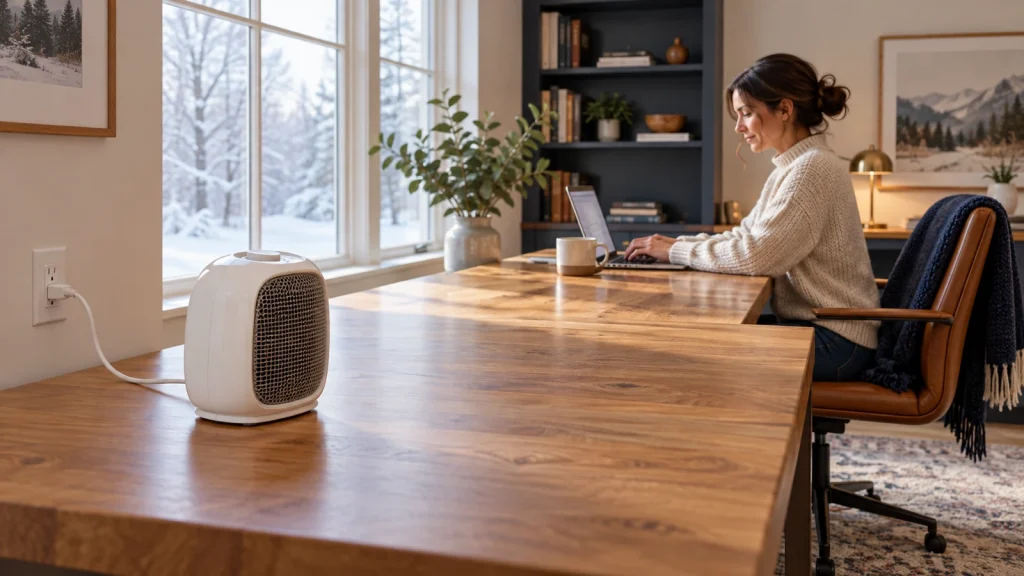
The best low wattage space heaters provide supplemental warmth where you sit without the electrical draw of a typical 1,500-watt heater. They make the most sense at a chilly desk or seated work area in a home that already has some background heating.
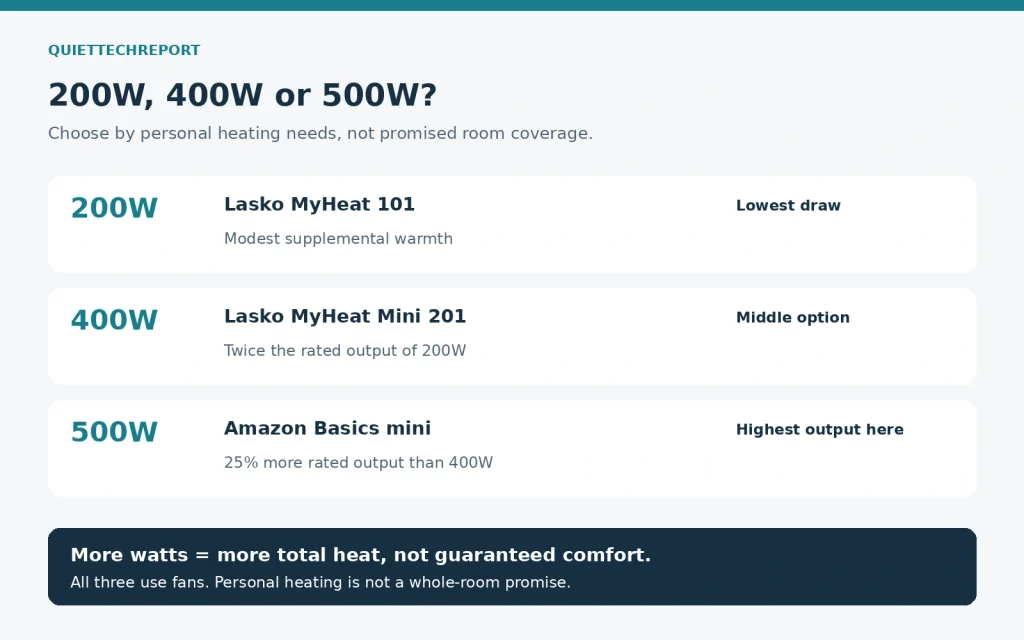
For simple 200-watt personal warmth, consider the Lasko MyHeat 101. The Lasko MyHeat Mini 201 offers a step up to 400 watts, while the Amazon Basics 500W mini ceramic heater provides the highest rated output in this shortlist.
These are personal heaters, with clear limits on whole-room heating. A small heater may help you feel warmer nearby while leaving the rest of a cold or drafty room uncomfortable. Choose according to the warmth you need at your seat, the available placement space, and your tolerance for fan noise.
As an Amazon Associate, QuietTechReport earns from qualifying purchases.
Quick Comparison: Low-Wattage Personal Heaters
| Heater | Best fit | Rated power | Heating style | Main limitation |
|---|---|---|---|---|
| Lasko MyHeat 101 | Lowest power draw in this shortlist | 200W | Ceramic element with fan | Limited output; no adjustable thermostat |
| Lasko MyHeat Mini 201 | More output than the 200W MyHeat | 400W | Ceramic element with fan | One heat setting; personal heating scope |
| Amazon Basics mini ceramic heater | Highest output in this shortlist | 500W | Ceramic element with fan | Audible fan; limited temperature control |
Lasko describes its MyHeat models as focused personal heaters. The Amazon Basics listing identifies a compact 500W ceramic heater with tip-over protection. These selections are based on documented specifications and intended use, rather than comparative hands-on testing.
Is a Low-Wattage Heater Right for You?
A low-wattage personal heater is worth considering when:
- You feel chilly while sitting still, although the home’s heating is running.
- You need supplemental warmth at one workstation.
- You want a heater with a genuinely low maximum draw.
- You have enough clear space to position it according to its instructions.
It is a less suitable choice when you need to warm an entire cold bedroom, heat an open living area, or compensate for strong drafts.
Buying a smaller heater works best when the heating task is smaller, too. A lower electricity draw cannot make up for inadequate heat output.
Lasko MyHeat 101: Best for Simple 200-Watt Personal Warmth
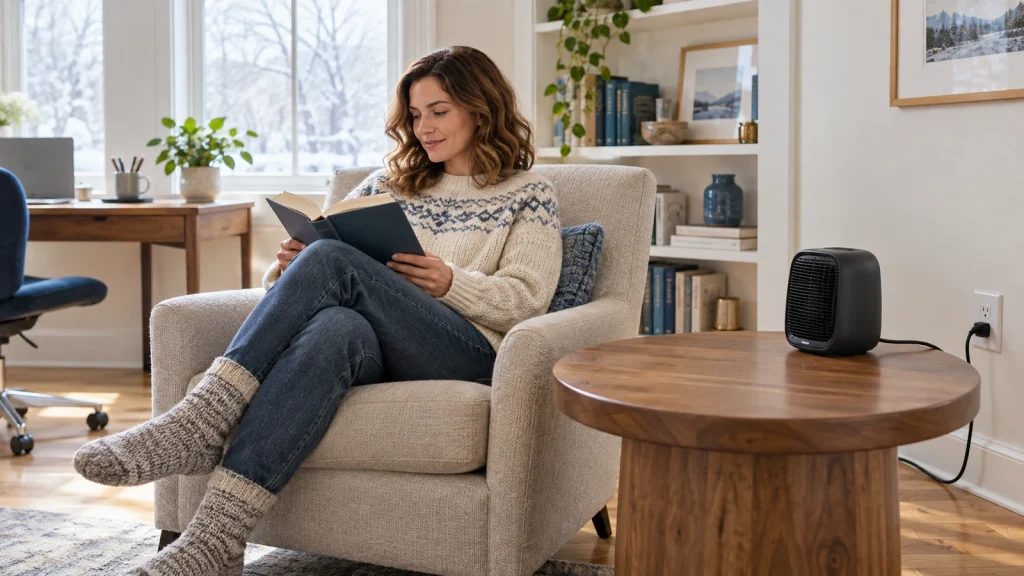
The Lasko MyHeat 101 is the lowest-wattage option in this comparison. It is a sensible starting point when your room already has background heating but you want supplemental warmth while sitting at a desk.
Specifications and features
| Feature | Lasko MyHeat 101 |
|---|---|
| Rated heating power | 200W |
| Heating system | Ceramic element with built-in fan |
| Controls | Manual on/off switch; one heat setting |
| Adjustable thermostat | None |
| Timer and oscillation | None |
| Dimensions | Approximately 3.8 inches deep × 4.3 inches wide × 6.1 inches high |
| Power connection | Standard 120V outlet; six-foot cord |
| Listed safety features | Overheat protection and cool-touch housing |
| Certification | ETL Listed |
| Warranty | Three-year limited warranty |
Lasko identifies the 101 as a personal heater intended to direct warmth toward its user. It arrives fully assembled and has no remote or adjustable tilt.
What its 200W output means in practice
At rated power, 200W corresponds to approximately 682 BTU per hour. That is about 13% of the heat output of a 1,500W resistance heater operating continuously.
Our assessment is that this makes the 101 most appropriate for taking the edge off a chill at one occupied workstation. It is a less convincing choice when the entire room feels cold or drafts continually remove warmth.
The important buying question is whether modest supplemental warmth will be enough. Choosing the lowest wattage saves electricity per operating hour, but buying too little heating capacity can leave you uncomfortable.
Controls and everyday use
Its fixed setting keeps operation straightforward: switch it on when you need warmth and off when you have enough. There is no room-temperature target to select.
That simplicity suits someone who prefers minimal controls. It is less convenient if you want the heater to maintain comfort automatically as conditions change throughout the day.
Noise considerations
Lasko describes its built-in fan as quiet, but the documentation reviewed does not provide a comparable decibel measurement. The 101 should therefore be treated as a fan heater rather than a silent heating option.
QuietTechReport has not tested whether its sound would be noticeable during calls or recordings.
Running cost
At $0.20 per kWh, calculated continuous-operation costs are:
- One hour: $0.04
- Four hours: $0.16
- 30 days at four hours daily: $4.80
Choose it for: modest personal warmth when keeping maximum power draw low is your main priority.
Consider another option if: you need substantially more heat, selectable power levels, or automatic room-temperature control.
Lasko MyHeat Mini 201: Best for a Step Up to 400 Watts
The Lasko MyHeat Mini 201 is the white 400W model. It offers twice the rated heating power of the MyHeat 101 while retaining a small personal-heater format.
Specifications and features
| Feature | Lasko MyHeat Mini 201 |
|---|---|
| Rated heating power | 400W |
| Heating system | Ceramic element with built-in fan |
| Heat settings | One |
| Controls | Front-mounted manual controls |
| Listed dimensions | Approximately 4.28 inches deep × 3.77 inches wide × 6.2 inches high |
| Listed weight | Approximately 1.1 pounds |
| Cord length | Six feet |
| Listed safety features | Overheat protection and cool-touch housing |
| Certification | ETL Listed |
| Manufacturer-listed warranty | Three years |
The dimensions and weight above come from the exact Amazon listing for model 201. Lasko’s product information confirms its 400W output, personal-heating purpose, six-foot cord, and warranty.
How it differs from the 200W MyHeat
The main difference is heating capacity. At rated power, 400W corresponds to approximately 1,365 BTU per hour, compared with approximately 682 BTU per hour for the 101.
That is twice the total heat production, although it does not establish twice the warmth at your seat. Airflow direction, surrounding temperature, clothing, and permitted placement all affect what you feel.
Our assessment is that the 201 provides a useful middle ground for someone who wants more output than 200W while keeping maximum draw below 500W.
Controls and placement
Its front-mounted controls are convenient when the heater is positioned facing you: you can operate it without turning the unit around. However, the single heat setting means it does not provide a selectable 200W mode.
The small enclosure can make storage easier, but the space needed for safe operation is much greater than its footprint. Check the instructions and surrounding clearances before deciding that it will fit at your workstation.
Noise and heating expectations
Lasko describes the built-in fan as quiet, but the reviewed information does not establish a standardized sound rating. We cannot rank the 201 as quieter than the 101 or Amazon Basics model.
Its higher wattage also does not establish whole-room performance. Think of the extra output as additional capacity for your personal-heating task, rather than a guaranteed solution for a cold bedroom.
Running cost
At $0.20 per kWh, calculated continuous-operation costs are:
- One hour: $0.08
- Four hours: $0.32
- 30 days at four hours daily: $9.60
Compared with the 101, that is an additional $4.80 per month under the same four-hour daily routine.
Choose it for: a compact personal heater with more heating capacity than the 200W MyHeat.
Consider another option if: you need adjustable output, documented low-noise performance, or room-temperature management.
Amazon Basics 500W Mini Ceramic Heater: Best for Higher Output in a Compact Package
The Amazon Basics 500W mini ceramic heater provides the highest rated heating power in this shortlist.
Specifications and features
| Feature | Amazon Basics 500W Mini Heater |
|---|---|
| Rated heating power | 500W |
| Heating system | Ceramic fan heater |
| Intended format | Compact tabletop personal heater |
| Listed weight | Approximately 1.4 pounds |
| Approximate size | About six inches tall |
| Power supply | Corded electric; 120V |
| Listed safety feature | Tip-over protection |
| Advertised noise level | 48 dB; measurement conditions unspecified |
Amazon’s product bullets give dimensions of 5.87 inches deep × 3.15 inches wide × 5.95 inches high, while its specification table gives slightly different measurements. Treat those figures as approximate when planning placement. The listing states that tip-over protection shuts the heater off if it is knocked over.
What the extra 100W provides
At rated power, 500W corresponds to approximately 1,706 BTU per hour.
That is:
- 25% more rated heat output than the 400W Lasko 201.
- 2.5 times the rated heat output of the 200W Lasko 101.
- Approximately one-third the output of a 1,500W heater operating continuously.
Our assessment is that it deserves consideration when maximizing output within this low-wattage shortlist matters more than minimizing electrical draw. The increase over 400W is useful capacity, but it should not be assumed to transform room-heating performance.
Size and portability
Its listed 1.4-pound weight makes it easy to carry between permitted locations.
Before buying, consider the usable space around the heater rather than its enclosure alone. A compact appliance may still be unsuitable for a crowded desk containing papers, cables, and other items.
Noise deserves attention
The advertised 48 dB figure lacks the measurement distance and operating conditions needed for a fair comparison. It is a listing claim, not a QuietTechReport test result.
We therefore cannot conclude that it is louder than either Lasko model. However, buyers prioritizing a very quiet workspace should investigate its fan sound before choosing it.
Controls and buying limitations
The reviewed listing does not establish an adjustable room thermostat or multiple selectable wattages. Buyers who need either feature should confirm the exact unit’s controls and manual before purchasing.
Tip-over protection is a useful documented feature, but it should not be interpreted as evidence of every other safety function.
Running cost
At $0.20 per kWh, calculated continuous-operation costs are:
- One hour: $0.10
- Four hours: $0.40
- 30 days at four hours daily: $12.00
Under that routine, it costs $2.40 more per month than the 400W Lasko and $7.20 more than the 200W Lasko.
Choose it for: the greatest rated heating output among these three compact personal heaters.
Consider another option if: your priorities are fanless operation, precise temperature control, or the lowest possible electrical draw.
Should You Choose 200W, 400W, or 500W?
Start with your heating goal rather than a square-foot coverage claim.
| Your priority | Option to consider | Tradeoff |
|---|---|---|
| Lowest operating draw | 200W | Least total heat |
| More output while staying below 500W | 400W | Twice the draw of 200W |
| Highest output in this shortlist | 500W | Greater consumption and audible fan operation |
| Comfortable temperature throughout a cold room | Assess room-heating requirements | A personal heater may be insufficient |
A heater’s usefulness depends on how its warmth reaches you. There is no universal distance at which a particular wattage will feel comfortable.
Do not compensate for weak warmth by moving the heater inside its required clearances. If it cannot meet your needs from a permitted position, choose a more suitable heating approach.
Why Low Wattage Does Not Mean Greater Heating Efficiency
Electric resistance heaters convert essentially all the electricity they consume into heat at the point of use. Lower wattage reduces heat production along with electricity consumption.
The advantage of a personal heater is matching the heat output and placement to a smaller task.
For example, warming your immediate seating area may require less total heat than raising the temperature throughout a room. That does not mean a 200W heater produces the same heat as a 1,500W heater.
Also distinguish the heater’s running cost from your household heating bill. Adding a personal heater while leaving all other heating unchanged adds electricity use. Whether it reduces total costs depends on how your main heating system is operated.
How Much Do Low-Wattage Space Heaters Cost to Run?
Use this formula:
Cost = watts ÷ 1,000 × operating hours × electricity rate
The examples below use $0.20 per kWh and assume continuous operation at rated power.
| Heater power | Electricity used in 4 hours | Cost per hour | Cost for 4 hours | Cost for 30 days at 4 hours/day |
|---|---|---|---|---|
| 200W | 0.8 kWh | $0.04 | $0.16 | $4.80 |
| 400W | 1.6 kWh | $0.08 | $0.32 | $9.60 |
| 500W | 2.0 kWh | $0.10 | $0.40 | $12.00 |
| 1,500W reference | 6.0 kWh | $0.30 | $1.20 | $36.00 |
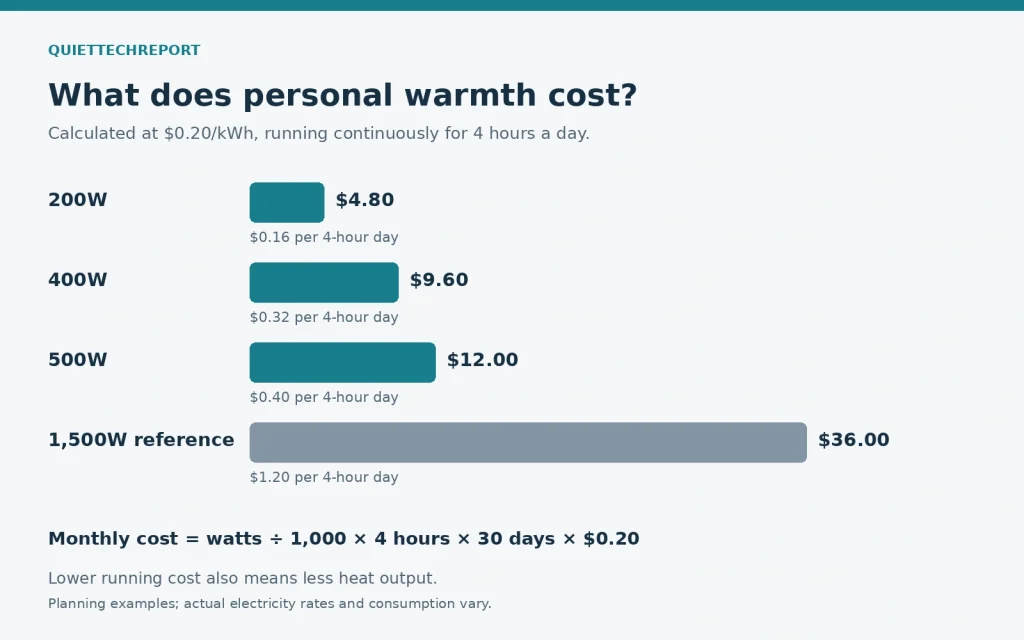
These are calculated examples, not measured energy-use results. Actual consumption can vary with the appliance’s operation and any normal thermostat cycling.
For a fixed-output personal heater without room-temperature control, use the full operating time when budgeting. Overheat protection is a safety feature, not an energy-saving thermostat.
Use our Space Heater Electricity Cost Calculator to compare wattages, your electricity rate, and different daily routines.
Are Low-Wattage Personal Heaters Quiet?
Low wattage alone does not tell you how much noise a heater makes.
All three products in this comparison use fans. Sound at your seat depends on the fan, airflow, distance, and the surrounding background noise.
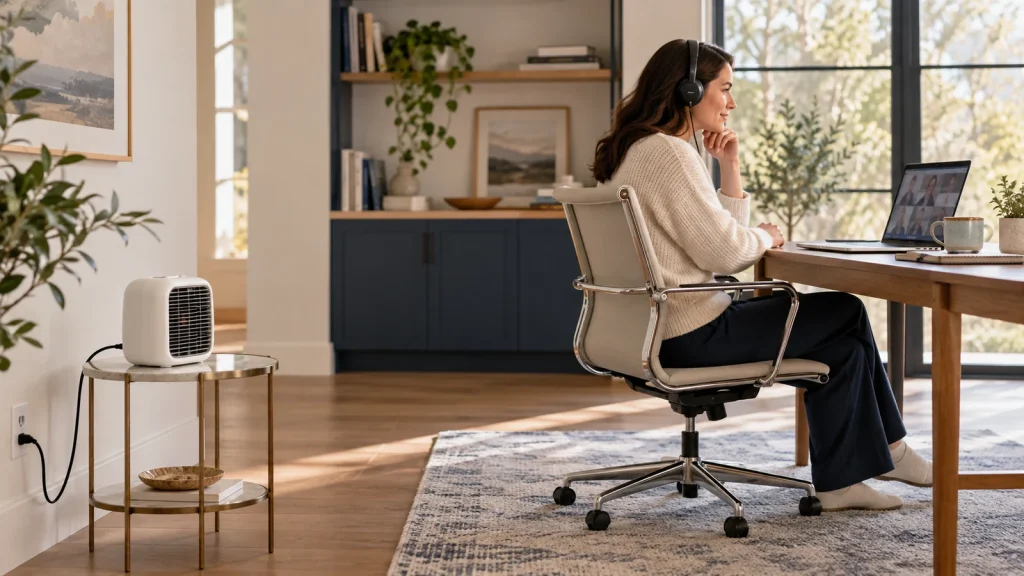
Before buying, consider:
- Whether steady fan sound would interrupt calls or concentration.
- Whether a desk could transmit vibration.
- Whether the product has a documented sound measurement with a stated distance and operating mode.
- Whether you actually need a fanless heater instead.
We have not measured these heaters under matching conditions, so this guide does not identify a quietest model or promise performance below 40 dBA.
If a personal heater develops a new buzz or rattle, our guide to noisy space heaters explains the permitted external checks and signs that require discontinued use.
For broader fanless options, see our Best Quiet Oil-Filled Radiator Heaters guide.
Safe Placement at a Desk or Seated Work Area
A small heater still needs a suitable location.
CPSC guidance recommends keeping portable heaters at least three feet from combustible materials, placing them on a stable surface, avoiding extension cords and power strips, and switching them off when unattended or sleeping. Follow the exact model’s instructions as well.
Check the space before buying
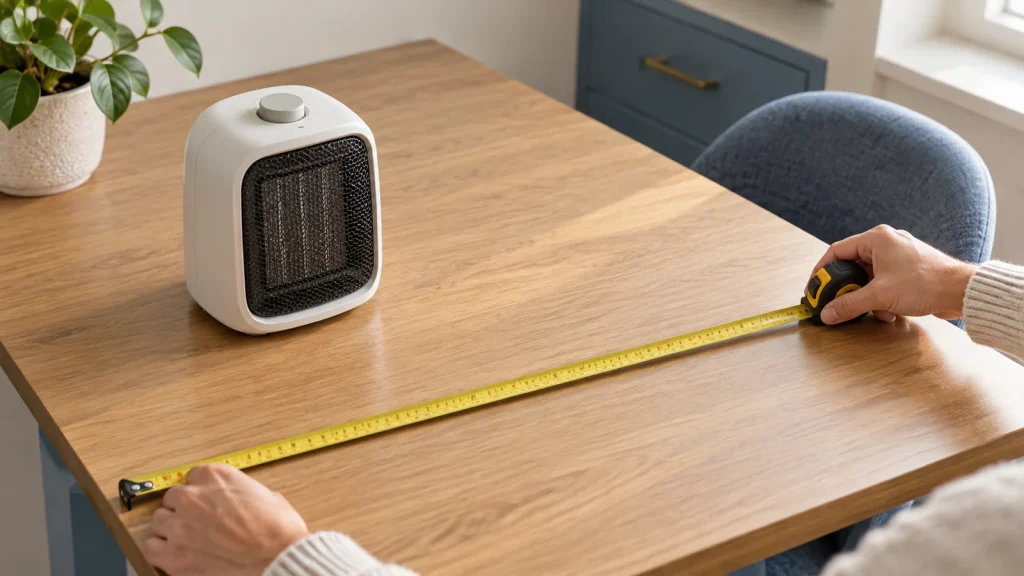
- Read the manual. Confirm permitted surfaces, orientation, and clearances.
- Check combustible items. Include papers, curtains, upholstered chairs, clothing, and stored materials.
- Allow for chair movement. The heater should remain stable when you sit down or move.
- Keep airflow openings clear. Do not enclose the heater in a cabinet or crowded storage space.
- Reach a wall outlet directly. Avoid an extension lead or power strip.
- Protect the cord. Keep it out of chair-wheel paths and do not run it beneath rugs.
If your desk cannot accommodate the required clearances, it is not a suitable heater location.
Do not confuse safety features
Overheat protection responds to excessive internal temperature. Tip-over protection responds to the heater being knocked over. One does not establish the presence of the other.
Neither feature makes unattended use appropriate. Stop using a heater if its plug or outlet becomes unusually hot, or if you notice damage, smoke, or a burning smell.
When a Personal Heater Will Not Be Enough
Reconsider a low-wattage model if:
- You need several people to feel comfortable across the room.
- The space remains cold even when the main heating is operating.
- Strong drafts continually cool the occupied area.
- You need to maintain a selected room temperature.
- Safe placement puts the heater too far from your seating position to be useful.
Room heating depends on heat loss, insulation, outdoor temperature, and existing heat—not floor area alone.
Our What Size Space Heater Do I Need? guide explains the next step when your goal is warming the room.
Frequently Asked Questions
Is a 200-watt space heater enough?
It can be useful for supplemental personal warmth in an already heated space. Whether it feels sufficient depends on surrounding temperature, placement, airflow, and your comfort needs. Do not treat 200W as a whole-room heating recommendation.
Can a 500-watt heater warm a small room?
It can contribute heat, and may raise temperature in a space with sufficiently low heat loss. However, a compact personal heater should not be assumed to maintain comfortable conditions throughout every small room.
Does a low-wattage heater save money?
It costs less per operating hour than a higher-wattage heater running continuously at the same electricity rate. It also produces less heat. Total household savings depend on whether other heating use changes.
Is a low-wattage heater safer under a desk?
Lower draw does not establish that a location is safe. Required clearances, stable placement, unobstructed airflow, and the manufacturer’s instructions still apply.
Can I run two low-wattage heaters on one circuit?
Do not judge this from the heaters alone. The circuit’s other loads and electrical condition matter. Follow the appliance instructions, and do not treat a breaker that repeatedly trips as a normal operating condition. If your space heater keeps tripping the breaker, investigate the cause before treating lower wattage as the solution.
Is a small heater the same as a low-wattage heater?
No. A compact heater can still draw 1,500W. Check both the selectable settings and maximum rated power before buying.
Which Low-Wattage Personal Heater Should You Choose?
Choose the Lasko MyHeat 101 if your priority is simple 200W supplemental warmth. Consider the Lasko MyHeat Mini 201 when you want a step up to 400W. The Amazon Basics 500W mini heater offers the highest rated output here, with an advertised noise level that deserves attention in a quiet workspace.
All three serve a limited heating task. If your goal is a comfortable temperature throughout a cold room, assess the room’s heating needs before buying.
Sources and Research Method
This guide uses manufacturer information and Amazon listing details reviewed October 11, 2026. Recommendations reflect documented features and intended uses. QuietTechReport has not performed comparative heating, power-consumption, or noise tests on these models.
- Lasko MyHeat 101 manufacturer specifications.
- Lasko’s MyHeat series product announcement.
- Amazon listings for the exact products linked above.
- Australian Government guidance on electric resistance heating.
- U.S. Consumer Product Safety Commission guidance on portable heater placement and operation.