Why Does My Space Heater Keep Shutting Off? Normal Cycling vs. Problems
Researched and reviewed by Dustin Sosko
Published: October 11, 2026
If your space heater keeps shutting off, it may be maintaining the thermostat temperature, reaching a timer limit, activating tip-over protection, or responding to overheating. A household electrical interruption can also make the heater appear to have shut itself off.
The most useful clue is what happens immediately before and after it stops. Does it restart as the room cools? Does it stop after the same number of hours? Was it bumped? Does it work again only after cooling or resetting?
Manufacturer guidance distinguishes these behaviors, but the exact controls, fan operation, and reset procedure depend on your model.
This guide covers portable electric space heaters. Gas, propane, and kerosene heaters require different troubleshooting procedures.
If the shutdown happens alongside clicking, buzzing, popping, or rattling, our space heater noise guide covers the sound separately and explains which accompanying symptoms require attention.
Stop Using the Heater If You Notice These Warning Signs
Stop troubleshooting through repeated restarts if there is smoke, melting, visible electrical damage, a persistent burning smell, or a hot plug or outlet.
CPSC advises disconnecting a heater with a hot cord or plug and contacting an authorized repair person. If the outlet is hot, contact an electrician.
Do not bypass a safety switch, open the heater to replace internal components, or keep resetting a unit that repeatedly activates its safety cutoff. Vornado’s VTH manual specifically directs users to contact support when the safety system repeatedly trips or will not reset.
Quick Diagnosis: Why Is Your Space Heater Turning Off?
Use the following table to choose your first check. These are possible explanations, not confirmation that a particular component has failed.
| What happens | Possible explanation | What to check first |
|---|---|---|
| Heat stops near the selected temperature and returns as the room cools | Normal thermostat or ECO cycling | Operating mode and temperature setting |
| Shutdown happens after a predictable runtime | Timer, automatic shutoff, or built-in schedule | Timer indicators and the manual’s runtime settings |
| Heater stops after a bump or unstable placement | Tip-over protection | Upright position, level surface, and correct base assembly |
| Heater runs briefly, stops, and requires cooling or resetting | Overheating protection or another fault | Accessible vents, placement, and the prescribed reset procedure |
| Fan continues briefly after heat stops | Normal cooldown on some models | The manual’s shutdown sequence |
| Display goes dark while airflow continues | Display dimming or sleep behavior | Display settings and operating indicators |
| Heater and other equipment lose power together | Household circuit interruption | Whether a breaker, fuse, or GFCI has operated |
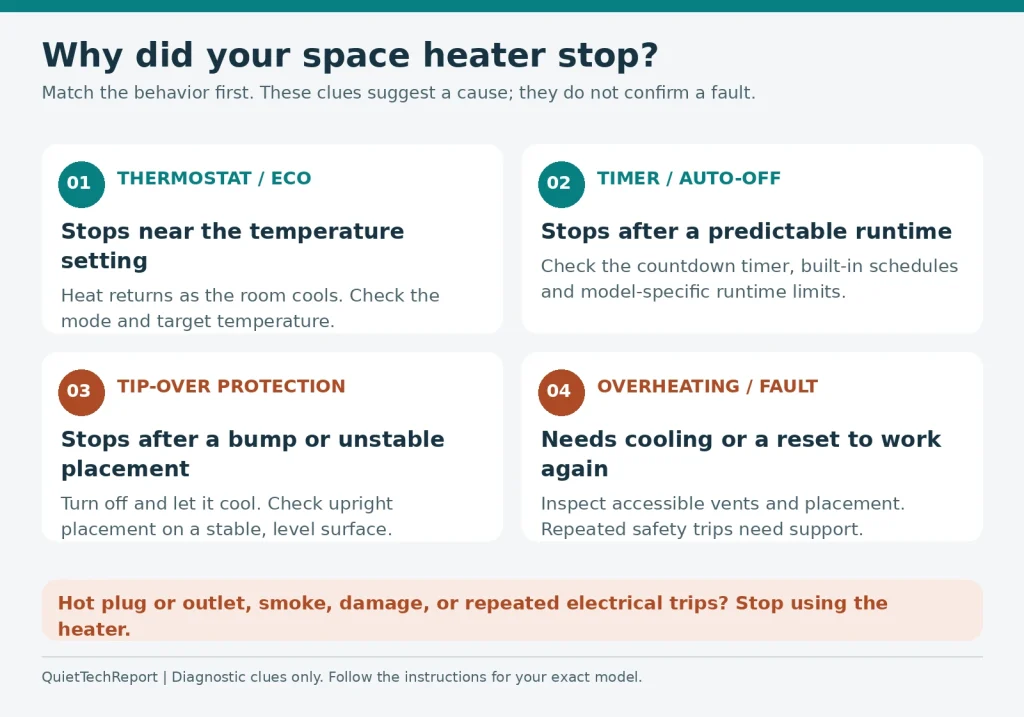
Manufacturer documents describe these separate behaviors, including thermostat stops, cooling sequences, tip-over shutdowns, and household power interruptions.
Temperature-related cycling, predictable timer shutdowns, unstable placement, and shutdowns requiring a reset point toward different checks.
First, Identify What Actually Shut Off
Before changing settings, record what you observed:
- Did the heater stop producing heat?
- Did the fan stop?
- Did only the screen turn off?
- Did an indicator light remain illuminated?
- Was there a beep, countdown, or error code?
- Did anything else in the room lose power?
A stopped heating element does not necessarily mean the entire appliance has lost power. Likewise, a dark screen does not prove that the heater is off.
For example, Dreo documents an automatic brightness feature on its MC706 and a 30-second fan countdown after switching off. These are model-specific behaviors that can be mistaken for a malfunction.
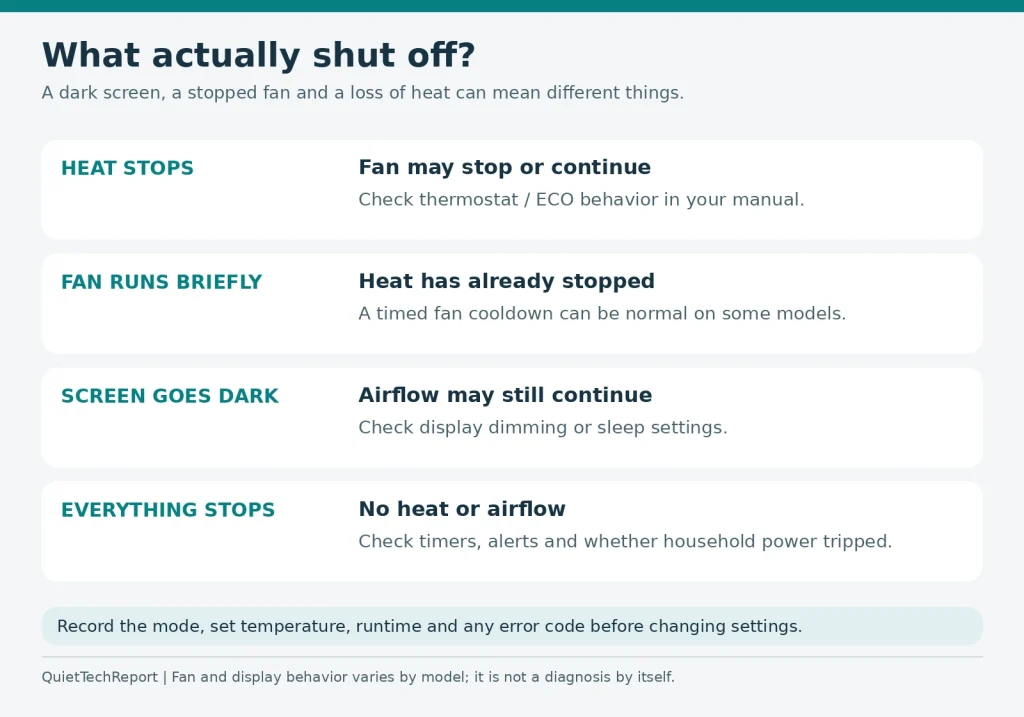
Check heat, airflow, the display, and household power separately before deciding what caused the shutdown.
Normal Thermostat Cycling: When Turning Off Is Expected
A thermostat-controlled heater does not necessarily produce heat continuously. Once its temperature control is satisfied, it may stop heating and restart when the temperature falls.
Some models stop both heat and airflow. Others reduce heating output and fan speed before stopping.
Vornado illustrates this difference in its manufacturer FAQs: the VH10 cycles heat and fan off at the selected temperature, while the AVH10 can lower output and fan speed to maintain comfort.
Normal cycling is more likely when:
- The heater is operating in a thermostat-controlled mode.
- Shutdown follows a rise in the heater’s temperature reading.
- Heating returns automatically as the temperature falls.
- The sequence matches the manual’s description.
The goal is maintaining temperature, not preventing every shutdown. Switching to continuous heat may change the behavior, but it is not a repair for a fault.
A Manual Example: Why a 72°F Setting May Not Switch at Exactly 72°F
The Lasko CS27600 manual describes an operating band in Automatic Temperature Control mode: heating stops two degrees above the setting and restarts one degree below it.
For a 72°F setting, that means a shutdown at 74°F and restart at 71°F. The manual also describes approximately 15 seconds of fan operation after a thermostat shutdown. Its separate Save-Smart mode behaves differently.
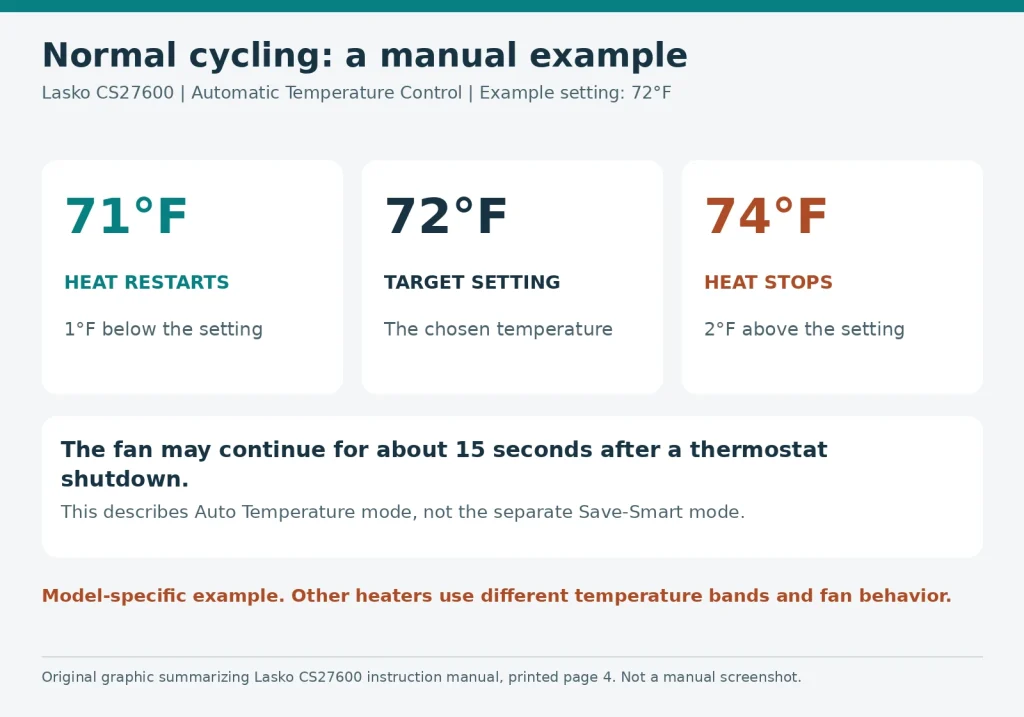
This example applies to the Lasko CS27600’s Automatic Temperature Control mode. Other models and modes use different control behavior.
Why Does It Shut Off When the Room Still Feels Cold?
Feeling cold elsewhere in the room does not establish that the heater’s thermostat has failed.
Compare three things:
- The target temperature: what you selected.
- The displayed temperature: what the appliance currently reports.
- A separate thermometer reading: measured at a recorded location.
Confirm whether the display shows the target or current temperature. Avoid comparing a thermometer directly in the hot-air stream with a reading taken across the room.
Dreo’s MC706 support guidance recommends comparing measured temperature beside the appliance with the displayed reading. Vornado’s VTH guide recommends placement representative of room temperature, away from temperature extremes such as drafts and heat registers.
Different readings are a reason to investigate placement and measurement conditions. They are not proof of a defective sensor.
If the controls behave as documented but the room remains uncomfortable, room size, drafts, and heating capacity are separate questions from unexpected shutdowns.
Timer and Automatic Shutoff Settings
A heater that stops after a consistent number of hours may be following a setting rather than responding to overheating.
Check for:
- A countdown timer.
- A timer icon or illuminated indicator.
- A built-in schedule, if supported.
- A separate automatic runtime limit.
Dreo documents a 24-hour automatic shutoff feature on its MC706 when that feature is enabled. Its Whole Room Heater 715 troubleshooting guidance also identifies an active timer as a possible reason for shutdown. These features are not universal.
A useful observation is whether the shutdown follows elapsed operating time or changes in temperature. Record the start and stop times during normal, supervised use.
Check built-in settings through the controls described in your manual. Avoid adding an external smart plug or timer as a workaround: Vornado warns against these devices for its heaters.
Tip-Over Protection: Check Placement and the Base
Tip-over protection interrupts operation when a suitably equipped heater is tilted or knocked over. Some models can restore power when returned upright, so switch the heater off before repositioning it.
The Vornado TH1 manual describes tip-over shutdown and directs users to place the heater on a level surface.
With the heater off, unplugged, and cool:
- Check that it stands upright on a stable, level surface.
- Confirm the base or feet were installed correctly.
- Make sure the cord is not trapped beneath it.
- Look for visible damage if it was knocked over.
Do not tape down, wedge, or bypass the safety switch. If the heater reports a tip-over condition while correctly positioned, use the exact model’s troubleshooting instructions or contact support.
Overheating Protection: Check Airflow Before Resetting
Thermostat cycling controls comfort. Overheating protection responds to an unsafe internal condition.
A heater can therefore activate overheating protection even when the room still feels cold.
Vornado’s VTH manual identifies blocked airflow and an obstructed fan as possible overheating causes. Lasko’s CS27600 manual says repeated shutdowns after several minutes may indicate that cleaning is needed.

Check the appliance only after switching it off, unplugging it, and allowing it to cool:
| Check | What to look for |
|---|---|
| Air inlet | Visible dust, lint, or an external obstruction |
| Air outlet | Furniture, fabric, or other objects blocking airflow |
| Placement | A confined position that does not meet the manual’s requirements |
| Surface | A soft or unstable location that could obstruct openings |
| Fan behavior | An unexpected absence of airflow on a fan-equipped model |
Clean accessible areas only as the manual permits. Do not insert objects through the grille or open the housing.
For example, Lasko’s CS27600 maintenance instructions specify vacuum cleaning with a brush attachment and prohibit disassembly.
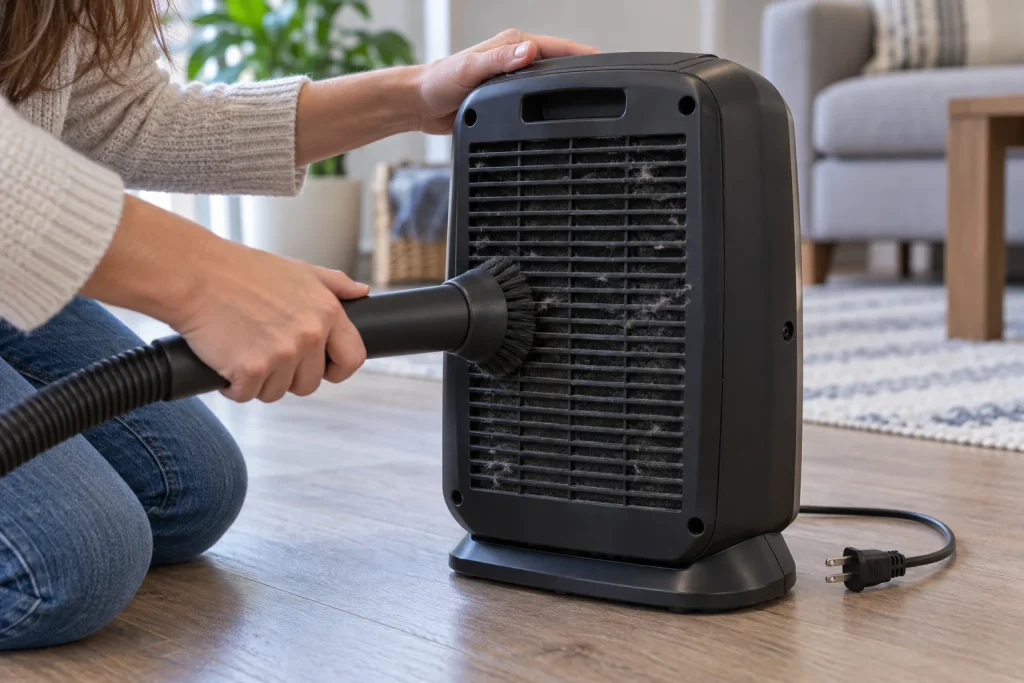
If shutdowns continue after permitted cleaning and correct placement, stop using the heater and contact its manufacturer.
Did the Heater Shut Off—or Did the Circuit Trip?
If the heater and other electrical equipment stop together, investigate household power rather than assuming normal thermostat cycling.
If a household breaker actually tripped, follow our space heater breaker-trip troubleshooting guide to assess shared loads and identify warning signs requiring professional attention.
A 1,500-watt heater operating at 120 volts draws approximately 12.5 amps. Other equipment on the same circuit can contribute to an overload. Vornado’s TH1 manual specifically identifies shared power loss as a possible circuit-overload clue.
Plug the heater directly into a suitable wall outlet and follow its electrical requirements. Lasko’s CS27600 manual prohibits extension cords, power strips, and other cord-connected adapters.
Do not repeatedly reset a breaker or GFCI to keep operating the heater. A protection device may be responding to overload or another electrical fault. Repeated trips need investigation; never substitute a larger breaker or bypass protection.
How to Reset a Space Heater Safely
Use the procedure for your exact model. Waiting periods and restart steps vary.
For the Vornado VTH, the owner’s guide describes switching off and unplugging, removing obstructions, allowing 5–10 minutes of cooling, and then reconnecting and switching on. It directs users to support if the safety shutdown repeats or the heater does not reset.
These reset instructions apply to the Vornado VTH. Follow the cooling time and procedure specified for your own heater.
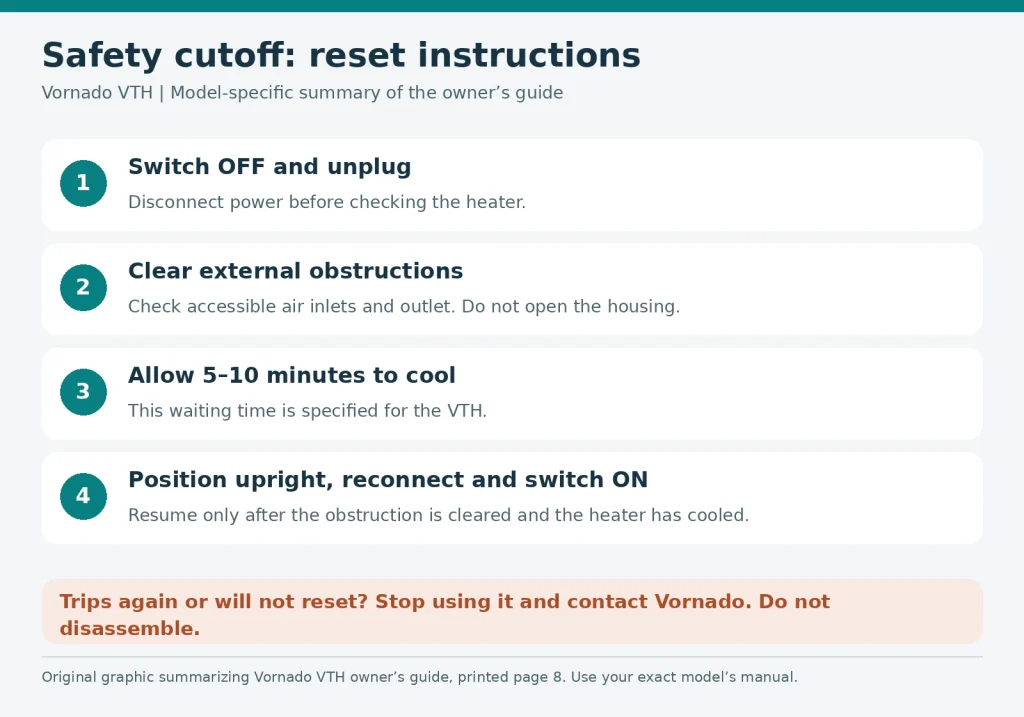
Lasko’s general support article instead specifies 10–15 minutes unplugged. That difference is why a single reset time should not be applied to every heater.
The model-specific Lasko CS27600 manual specifies a 10-minute cooling period, as shown in the excerpt below.

A successful reset means the heater operates again. It does not prove the original cause has been resolved.
What to Record Before Contacting Support
Give support an observation they can act on:
“The heater runs for about four minutes in ECO mode, stops with the display showing an error, and will not restart until it has cooled.”
Record:
- Model number.
- Operating mode and heat level.
- Target and displayed temperatures.
- Approximate runtime before shutdown.
- Any error code, beep, or countdown.
- Whether it restarts automatically.
- Whether household electrical protection tripped.
- Checks and permitted cleaning already completed.
Take photographs of the model label and any displayed error. Do not operate an unsafe heater again just to reproduce a fault.
Frequently Asked Questions
Why does my space heater shut off after a few minutes?
Possible causes include satisfying the thermostat or activating overheating protection. Lasko specifically identifies cleaning as a possible need when its CS27600 runs for several minutes and repeatedly shuts down. Check the mode, temperature behavior, and accessible vents before following the manual’s reset instructions.
Is it normal for the fan to run after the heat stops?
It can be. Some heaters use a brief fan cooldown; others allow continuous fan operation independently of heating. Check your model’s documented behavior.
Does a dark display mean the heater has turned off?
Not necessarily. Some models dim their displays automatically. Check airflow and operating indicators rather than relying on the screen alone.
Why does the heater work again after cooling down?
Cooling and resetting may restore operation after a thermal safety cutoff. If it repeatedly happens, investigate permitted maintenance and placement, then contact support rather than continuing to reset it.
Should I increase the thermostat to prevent shutdowns?
If the heater is cycling normally, choose a comfortable target temperature. Increasing the setting will not resolve a safety cutoff or electrical fault.
Sources and Research Method
This guide uses manufacturer manuals, manufacturer support guidance, and CPSC safety advice checked October 11, 2026. It does not present hands-on testing. The manual graphics summarize instructions for the named models; they are not manufacturer screenshots.