Best Quiet Oil-Filled Radiator Heaters: Detailed Comparison of 3 Fanless Options
Researched and reviewed by Dustin Sosko
Published: October 11, 2026
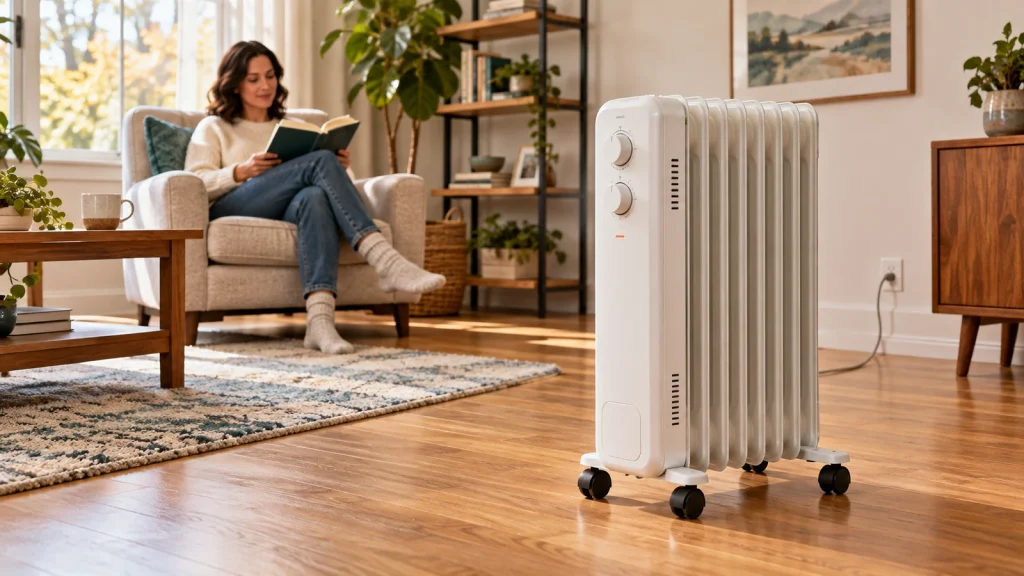
Oil-filled radiator heaters are worth considering when continuous fan noise is your main complaint. They warm their oil-filled metal bodies and transfer heat into the room without blowing air through a fan.
However, choosing a quiet radiator involves more than looking for the word “silent.” Thermostat switching, warming and cooling sounds, electronic beeps, illuminated controls, and the effort required to move the heater can all affect everyday use.
Our recommendations are the Dreo OH310, De’Longhi Dragon TRD40615E, and PELONIS PHO15A2AGW. Their Amazon listings showed purchase options when reviewed. Availability and delivery depend on the selected seller and location.
This guide compares their controls, heat settings, physical size, mobility, and practical limitations. The recommendations are based on published specifications and instructions, rather than hands-on testing.
For other heater types and related tools, explore our quiet space heater guides, comparisons, and calculators.
Still deciding whether a radiator fits your routine? Compare oil-filled, ceramic, and infrared heaters before choosing a model.
As an Amazon Associate, we earn from qualifying purchases.
Quick Comparison: Which Quiet Oil-Filled Heater Should You Choose?
| Heater | Best fit | Heat settings | Main control advantage | Main consideration |
|---|---|---|---|---|
| Dreo OH310 / DR-HSH010 | Remote adjustments and control over beeps and display light | 600W, 900W, 1,500W, and ECO | Remote, mute, screen-off function | Requires more familiarity with electronic controls |
| De’Longhi Dragon TRD40615E | Digital controls on a radiator kept mainly in one room | MIN, MED, MAX, and ECO; 1,500W maximum | Temperature buttons and adjustable display brightness | Substantially heavier than the other two |
| PELONIS PHO15A2AGW | Simple manual operation | 600W, 900W, and 1,500W | Separate heat-selector and thermostat dials | No digital temperature target, remote, or timer |
The controls and heating features come from manufacturer specifications and operating instructions. These categories describe buying fit, not a measured ranking from quietest to loudest.
Our first choice for convenience is the Dreo OH310. The PELONIS makes more sense if you prefer manual controls. Consider the De’Longhi when its digital panel appeals to you and frequent carrying is unlikely.
Dreo OH310: Best for Remote Control, Mute, and Display Options
The Dreo OH310, also identified as DR-HSH010, is the most natural starting point for buyers who want fanless heat with convenient adjustments from a nearby chair.
Its strongest distinction is the combination of a remote, digital thermostat, selectable output, and options for controlling electronic distractions. These are useful features for a home office, reading area, or living room where repeatedly getting up to change settings would be inconvenient.
Dreo OH310 Specifications
| Feature | Details |
|---|---|
| Heater type | Fanless oil-filled radiator |
| Heating levels | H1: 600W; H2: 900W; H3: 1,500W |
| Additional mode | ECO temperature control |
| Thermostat | 41–95°F, adjustable in 1°F increments |
| Manufacturer-listed timer | 1–24 hours |
| Controls | Touch panel and included remote |
| Convenience features | Mute, screen-off function, child lock |
| Electrical supply | 120V, 60Hz |
| Amazon-listed dimensions | 12.83 inches deep × 9.92 wide × 26.14 high |
| Amazon-listed weight | 17.6 pounds |
| Mobility | Casters and handle |
Dreo lists slightly different dimensions on its own website: 12.2 × 9.84 × 26.06 inches. Confirm the selected version and assembled wheel footprint when planning a tight space.
Power Heat and ECO Serve Different Purposes
In Power Heat, you select H1, H2, or H3. In ECO, you select a temperature target and the heater chooses its heating power according to the difference between the target and sensed temperature. Heating stops when the ECO target is reached.
That distinction helps explain the controls:
- Choose a power level when you want to select the heater’s output.
- Choose ECO when maintaining a temperature target is the priority.
- Do not assume ECO means the heater remains at 600 watts.
For a mildly chilly room, a lower setting may provide enough supplemental warmth. A colder space may need more output. Your room’s heat loss determines whether any setting can maintain the temperature you want.
The thermostat’s 1°F adjustment steps describe the settings available to you. They do not demonstrate that every part of the room will remain within 1°F of the displayed target.
A radiator stopping at its temperature target can be expected. If it repeatedly interrupts heating, check why a space heater turns off by itself before assuming the controls have failed.
What the Remote and Mute Function Actually Add
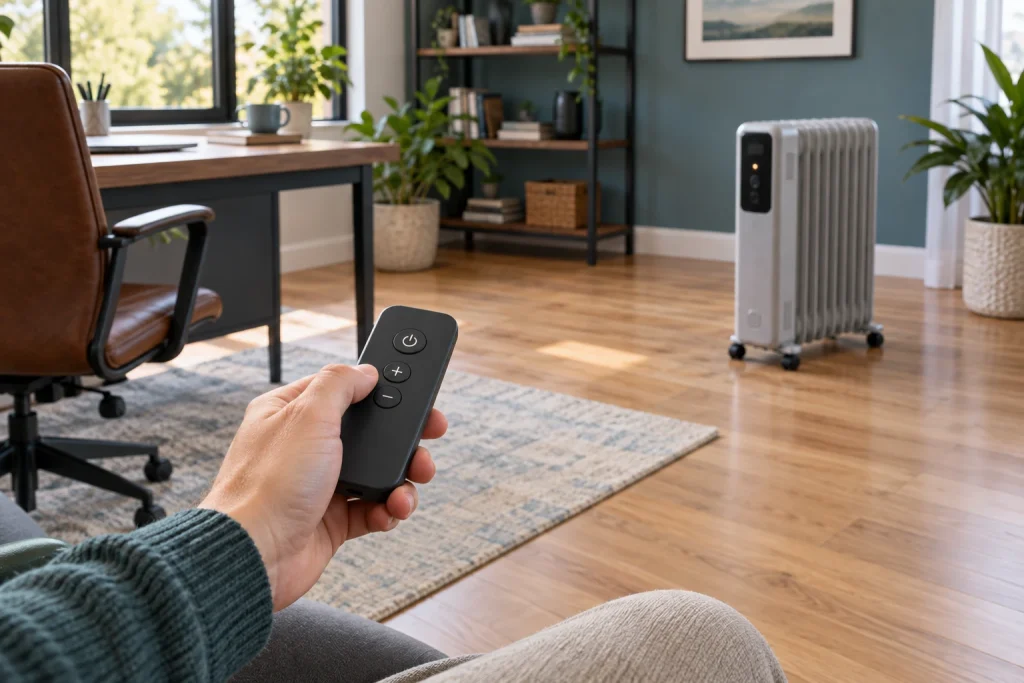
The remote is useful when safe heater placement puts the panel beyond easy reach. It allows you to adjust the heating routine without moving the radiator closer to furniture.
The manual describes mute as turning button sounds on or off. It also documents a memory function for the last temperature and operating mode.
Our assessment is that these features make the OH310 particularly convenient for someone who changes settings during a longer session. Screen-off controls also deserve attention if a lit panel is distracting while watching television or working in subdued lighting.
Mute is not evidence that thermostat switching or thermal sounds have disappeared. A remote is a convenience feature, not a reason to operate the heater while you are away.
Timer, Setup, and Protection Features
The operating instructions describe timed switch-off while the heater is running and delayed switch-on while it is off. They also document caster installation, child lock, tip-over shutdown, and overheat protection.
For supervised use, timed switch-off can be a useful backup to your normal routine. Set the heater up with its wheels correctly installed, and check the included instructions before relying on a particular timer behavior.
The child lock restricts control changes. It does not create a barrier around the radiator.
Dreo’s FAQ states that the surface may reach 80°C, approximately 176°F. It also explains that convection heating can take longer to warm the space.
Mobility and Everyday Fit
At the Amazon-listed 17.6 pounds, the OH310 is considerably lighter than the De’Longhi in this comparison. It is still a substantial heater to carry upstairs.
Our assessment: choose it primarily for rolling between nearby rooms or leaving it in a regular heating position. Measure doorway thresholds and storage space as well as the radiator body.
Reasons to choose it: Remote adjustments, documented button mute, display controls, and a choice between output selection and temperature control.
Reasons to consider another option: You prefer physical dials, dislike electronic menus, or regularly need to carry a heater between floors.
De’Longhi Dragon TRD40615E: Best for Digital Controls in a Regular Heating Spot
The De’Longhi Dragon TRD40615E is worth considering when you want an oil-filled radiator with a digital panel and expect it to remain mainly in one room.
Its design includes enclosed thermal channels intended to encourage natural convection. De’Longhi describes a larger radiant surface and increased convection compared with its reference radiator design. Those manufacturer claims do not establish that it heats your room faster than the Dreo or PELONIS under identical conditions.
The practical buying question is whether you prefer its panel, display controls, and physical design enough to accept the additional weight.
De’Longhi TRD40615E Specifications
| Feature | Details |
|---|---|
| Heater type | Fanless oil-filled radiator |
| Maximum power | 1,500W |
| Heating levels | MIN, MED, MAX |
| Additional mode | ECO |
| Normal temperature settings in reviewed manual | 50–82°F |
| Separate antifreeze setting | 41°F |
| Timer | Delayed start or stop, up to 24 hours |
| Display | Adjustable operating brightness |
| Control lock | Key-lock function |
| Amazon-listed dimensions | 16.4 inches deep × 10.3 wide × 26.1 high |
| Amazon-listed weight | 26.6 pounds |
| Mobility | Built-in folding wheels and handle |
The operating details above come from the TRD40615E/TRD40615EL manual. Match the exact model suffix and included instructions when ordering, because versions can differ.
How Its Digital Panel Changes Everyday Use
A digital target is convenient when you prefer selecting a number rather than finding a comfortable position on a thermostat dial.
Our assessment: this makes the Dragon a better fit than the PELONIS for someone who wants an easily repeatable starting setting. You can return to the same selected temperature, then assess comfort where you sit.
That does not mean the display replaces a room thermometer. Furniture, drafts, and distance from the heater can affect the temperature you experience.
The brightness adjustment is also worth considering if the radiator will sit within your normal line of sight. Evaluate display light separately from operating sound; a heater can be acoustically unobtrusive while its panel remains visually distracting.
ECO and Timer Behavior
The reviewed manual describes ECO selecting among available heating levels and stopping heating as needed. It also explains that the chosen power level limits the levels ECO can use.
Its timer provides a delayed start or delayed stop rather than a seven-day schedule.
The buying implication is straightforward: choose it if those controls match your routine. Do not pay for a timer expecting detailed weekday and weekend programming unless the exact version explicitly provides that feature.
ECO is a control strategy. It does not guarantee a particular reduction in your electricity bill.
Incidental Sounds Deserve Attention
The manual documents acoustic signals for key-lock activation and temperature-scale changes, plus creaking during initial use.
We therefore would not select the Dragon on an assumption of complete silence. Its fanless design removes continuous fan airflow, but the available documentation supports checking both electronic feedback and warm-up sounds.
Our assessment: if button beeps are your main irritation, the Dreo’s documented mute function gives you a clearer reason to choose it. If you rarely change settings and mainly want a digital panel, the Dragon remains a reasonable option to compare.
Weight, Wheels, and Storage
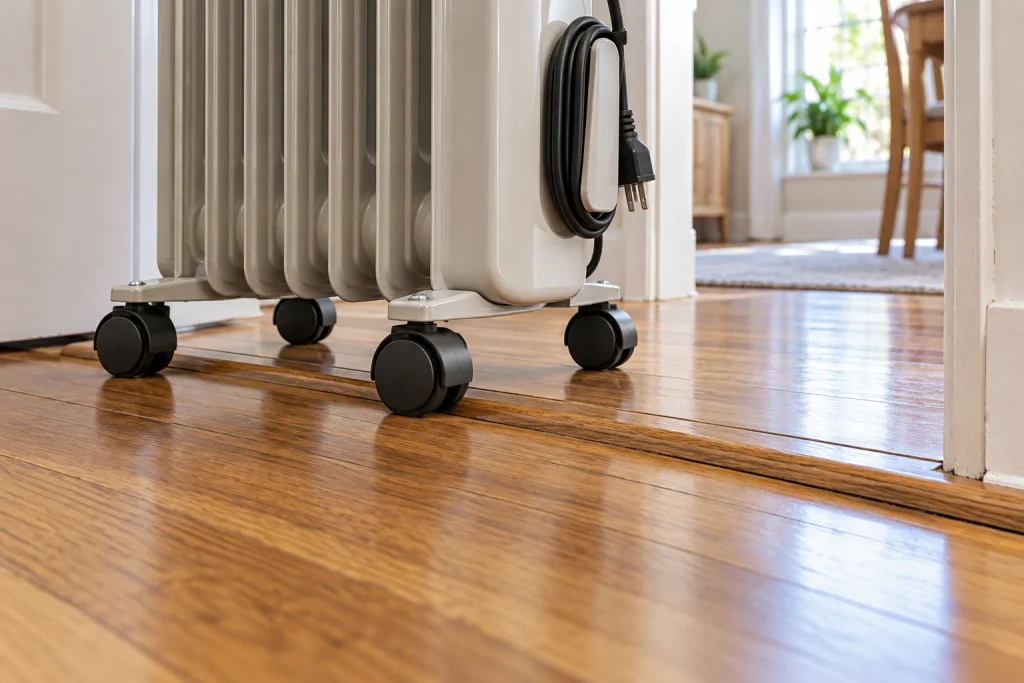
The listed 26.6-pound weight is the clearest physical disadvantage against the other two recommendations. Wheels help on a suitable floor; they do little for stairs.
De’Longhi describes built-in wheels, a handle, a steel assembly, and a permanently sealed oil reservoir that does not require refilling. Its current TRD40615E-6A page also lists a control lock and thermal cut-off.
Our assessment: the Dragon makes the most sense in a regular heating spot with adequate clearance and nearby storage. If you will move it daily, consider the route before ordering.
Reasons to choose it: Digital panel controls, display adjustment, built-in wheels, and a design suited to remaining in one room.
Reasons to consider another option: Frequent lifting, remote operation, or a documented button-mute function is important to you.
View the De’Longhi TRD40615E on Amazon
PELONIS PHO15A2AGW: Best for Straightforward Manual Operation
The PELONIS PHO15A2AGW suits buyers who want the essentials: selectable heating power, a thermostat dial, and wheels.
Its appeal is simplicity. There is no digital temperature menu to navigate and no remote to keep track of. This can be a useful choice when you intend to establish a comfortable setting and make only occasional adjustments.
PELONIS PHO15A2AGW Specifications
| Feature | Details |
|---|---|
| Heater type | Fanless oil-filled radiator |
| Heat settings | 600W, 900W, 1,500W |
| Thermostat | Mechanical MIN-to-MAX dial |
| Controls | Separate heat-selector and thermostat dials |
| Indicator | Power indicator light |
| Digital temperature display | None |
| Remote or programmable timer | None |
| Electrical supply | 120V, 60Hz |
| Maximum draw | 12.5A |
| Amazon-listed dimensions | 11 inches deep × 14.2 wide × 26.1 high |
| Amazon-listed weight | 7.6kg, approximately 16.8 pounds |
| Mobility | Four casters and front handle |
Manufacturer specifications and the operating manual support the heating and control details. Dimensions and weight above are from the selected Amazon listing.
The Two Dials Have Different Jobs
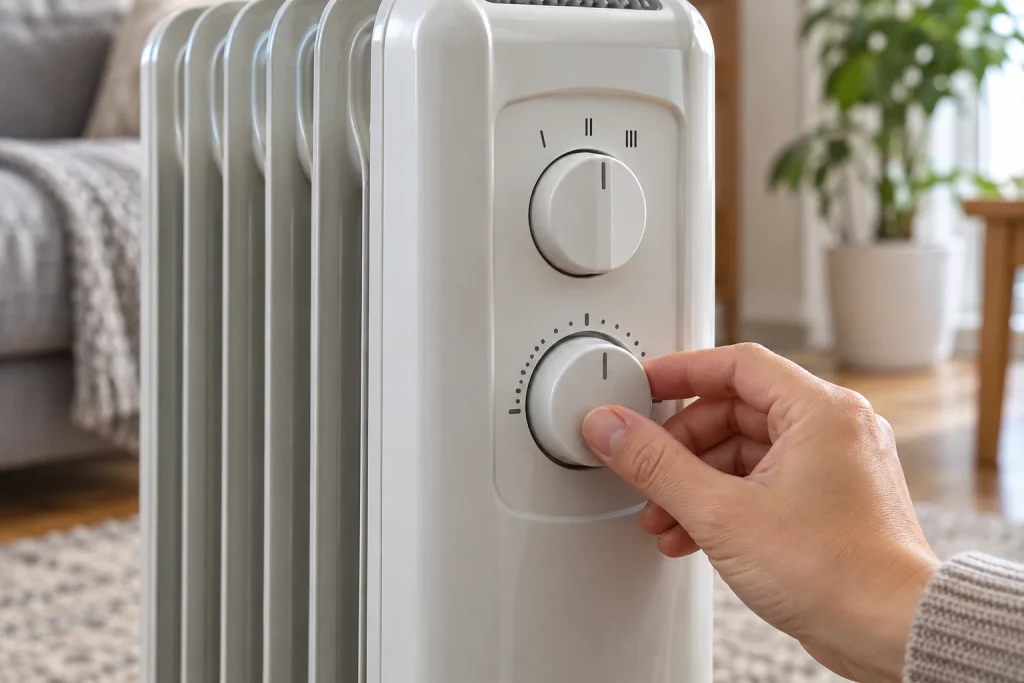
The heat selector chooses the available power setting. The thermostat dial establishes when heating should stop and resume.
PELONIS instructs users to let the room reach a comfortable temperature, then gradually turn the thermostat down until the heater stops. The thermostat subsequently cycles at that selected level.
Our assessment: this works well for someone comfortable adjusting by feel. It is less convenient when you want to enter a particular temperature immediately.
A separate thermometer can help you learn which dial position works in your room. Place it where you want to assess comfort, rather than immediately beside the radiator.
Choosing a higher thermostat position should not be confused with choosing a higher wattage setting. Treat the two controls as separate decisions: heating output and the desired stopping point.
What You Give Up by Choosing Manual Controls
The PELONIS does not provide the remote, digital target, or timer convenience of the electronic models.
That matters most if the heater’s safe position is inconvenient to reach or you often change settings during use. For a regular reading chair or home-office routine, consider whether walking to the radiator would become irritating.
Our assessment: choose the PELONIS because the simpler controls suit you. It is not automatically the better value merely because it has fewer functions; compare the current Amazon price with the features you will actually use.
Quiet Operation Still Includes Cycling
PELONIS describes quiet operation and permanently filled oil with metal fins. Its manual confirms that thermostat cycling is part of normal operation.
The manual design avoids electronic button feedback, but we have not measured its switching sounds or thermal ticks. There is no basis here to claim that it is acoustically quieter than either digital model.
Our assessment: the PELONIS is a useful candidate when you dislike displays and prefer physical controls. Listen through a complete heating cycle before deciding whether its intermittent sounds are acceptable.
Wheel Assembly and Placement
The manual requires attaching the wheel assemblies before operation and using the heater upright. It also calls for placement at least three feet from walls and other objects.
That placement requirement deserves attention before purchase. A compact body does not mean you can squeeze the radiator into an unused gap beside furniture.
The four casters and front handle favor moving it across a suitable floor. Its listed weight is lower than the De’Longhi’s, although carrying it remains different from rolling it.
Protection, Cleaning, and Storage
PELONIS lists overheat protection and a tip-over switch. The manual describes the heater resuming operation after it is returned upright.
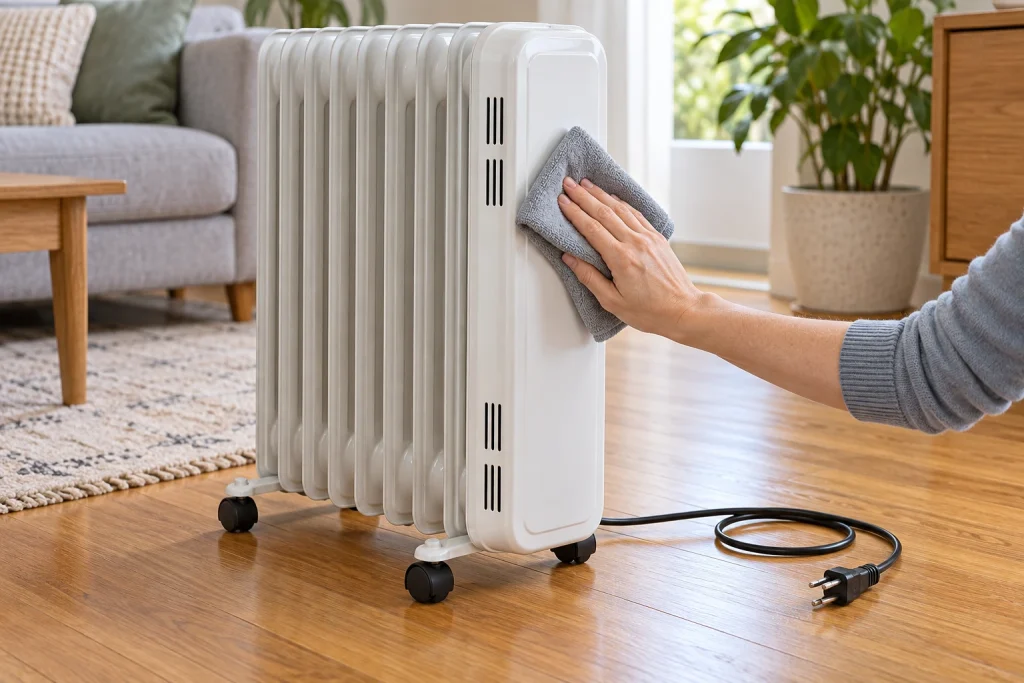
Cleaning instructions call for switching it off, unplugging it, allowing it to cool, and wiping exterior surfaces with a dry cloth. The reviewed manual includes a one-year limited warranty.
Reasons to choose it: Physical dials, three clear output settings, no digital menu, and straightforward operation.
Reasons to consider another option: You want remote adjustments, a numbered temperature target, or timed switch-off.
View the PELONIS PHO15A2AGW on Amazon
Compare the Controls You Will Actually Use
The best control system is the one that matches your routine.
| Your priority | Strongest starting point |
|---|---|
| Change settings from your chair | Dreo OH310 |
| Reduce electronic button sounds | Dreo OH310, using its documented mute function |
| Select a temperature on a digital panel | Dreo OH310 or De’Longhi TRD40615E |
| Avoid navigating digital controls | PELONIS PHO15A2AGW |
| Keep the radiator mainly in one room | Any of the three; the heavier De’Longhi is less convenient to carry |
| Frequently carry the heater upstairs | Reconsider the weight of a radiator before choosing any model |
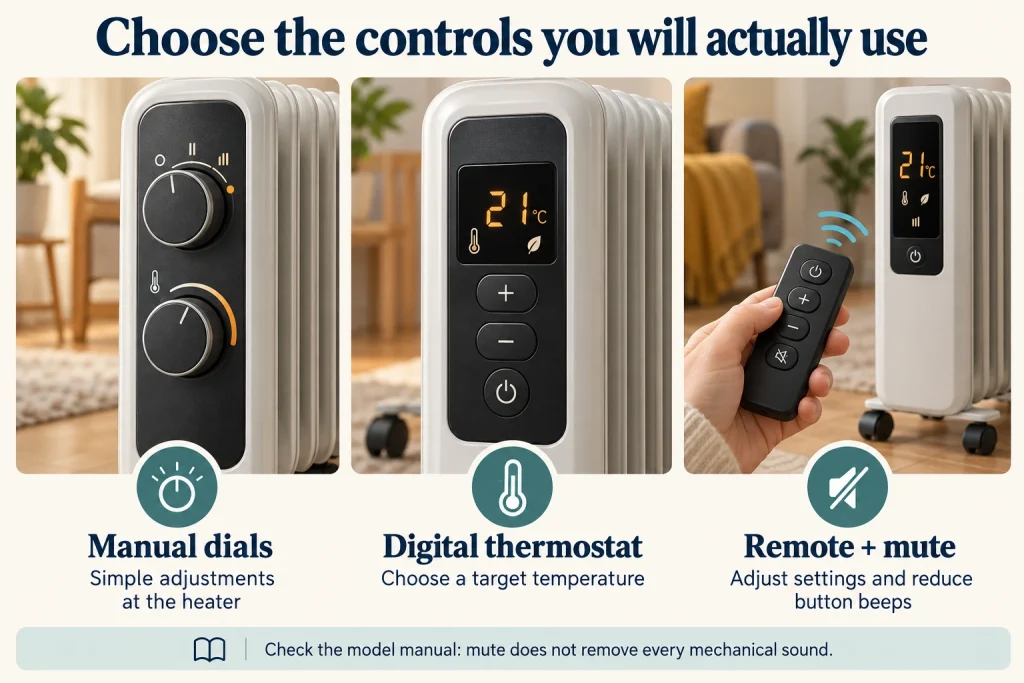
Compare manual dials, digital temperature controls, and remote operation before choosing an oil-filled radiator. Generic heater illustrations.
Fanless Does Not Mean Completely Soundless
Continuous fan noise and intermittent radiator sounds are different buying considerations.
| Sound | When it may occur | What to consider |
|---|---|---|
| Ticks, pings, or creaks | During warming or cooling | Evaluate a full heating session |
| Thermostat or switching clicks | As heating starts or stops | A quiet steady period can still include noticeable transitions |
| Electronic beeps | When changing controls or activating functions | Check for a documented mute option |
| Buzzing or sizzling at the outlet | At the electrical connection | Stop use and have the connection checked |
| Unusual noise with leakage or damage | During a fault or damaged condition | Discontinue use and contact the manufacturer |
De’Longhi’s guidance identifies metal contraction sounds during heating and cooling. Its radiator instructions also warn against continued use when oil leaks or the plug or cord shows abnormal overheating. A sound should be assessed alongside its location and any accompanying symptoms.
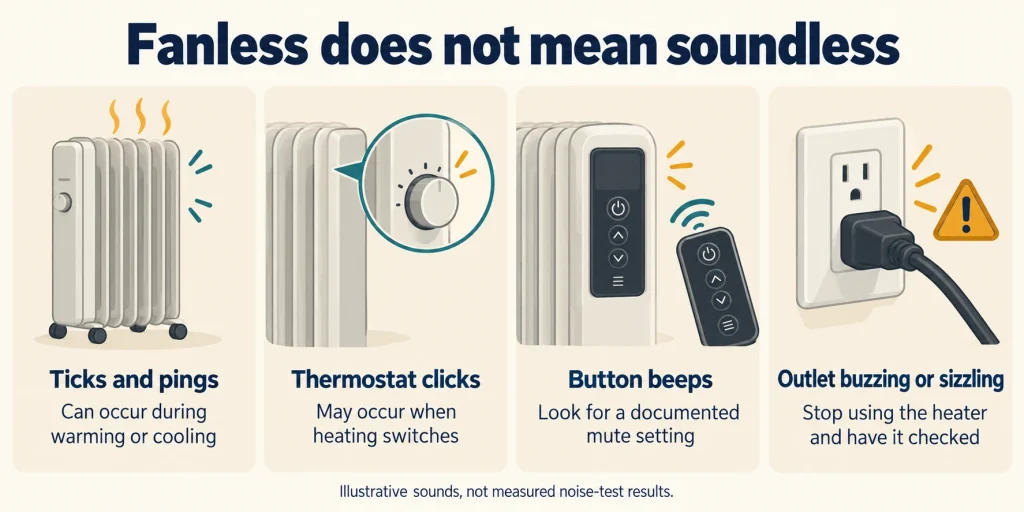
Fanless heaters can still make thermal ticks, thermostat clicks, and control beeps. Outlet buzzing or sizzling requires attention.
We have not assigned decibel ratings to these models. Manufacturer descriptions such as “silent” do not provide controlled measurements of every sound throughout a heating cycle.
If your radiator has developed a new sound, our guide to space heater clicking, popping, buzzing, and rattling explains what may be expected and when to stop using it.
How Much Do Oil-Filled Radiator Heaters Cost to Run?
Use the active heating wattage, operating time, and your electricity price to estimate cost.
At an example electricity price of $0.20 per kWh:
| Heating power | One hour of continuous heating | Four hours of continuous heating |
|---|---|---|
| 600W | $0.12 | $0.48 |
| 900W | $0.18 | $0.72 |
| 1,500W | $0.30 | $1.20 |
These calculated examples use:
Cost = watts ÷ 1,000 × active heating hours × electricity price
Thermostat cycling can reduce active heating time. However, a cold or drafty room may keep the element operating for much of the session.
For the same continuous power and duration, an oil-filled heater’s retained warmth does not create additional free energy. It releases heat that the radiator already stored.
Our assessment: buy the controls and heating behavior that suit your room. Do not assume a more expensive radiator automatically costs less to operate.
If your heating task is limited to one occupied workstation, compare compact low-wattage desk heaters as an alternative, weighing their lower rated output against the fan sound they produce.
Check Placement Before Buying
Before ordering, measure the proposed position and consider:
- Clearance from furniture, curtains, bedding, and other combustible materials.
- Any additional wall clearance required by the model’s manual.
- The assembled wheel footprint.
- A suitable wall outlet within reach of the original cord.
- The route between operating and storage locations.
CPSC advises keeping portable heaters at least three feet from combustible materials, plugging electric heaters directly into a wall outlet, and turning them off before sleeping. Do not use extension cords or power strips. Follow greater model-specific clearances where required.
Fanless operation does not mean low electrical demand. If your oil-filled heater trips the breaker, check the circuit’s shared loads and have recurring trips investigated.
For bedroom-specific buying considerations, read our quiet space heaters for bedrooms and nursery safety guide.
Frequently Asked Questions
Which recommendation is best for avoiding button beeps?
The Dreo OH310 has a documented button-mute function. That makes it the clearest starting point when electronic feedback is your main concern. It does not guarantee silent mechanical operation.
Which recommendation has the simplest controls?
The PELONIS PHO15A2AGW uses two manual dials: one for heat selection and one for thermostat adjustment. Choose it if you prefer that approach to a digital panel.
Will a 1,500-watt radiator heat any room?
No. Room size alone does not determine heating needs. Insulation, drafts, ceiling height, outdoor temperature, and the temperature increase you want all matter.
Treat advertised room coverage as a starting point rather than a guarantee.
Our sizing guide explains how big a room a 1,500-watt heater can heat and when supplemental warmth differs from supplying all the room’s heat.
Do I need to add or replace the oil?
These heaters use sealed oil reservoirs. The oil is a heat-transfer medium rather than fuel you routinely refill. Do not open a radiator to add oil.
Can I operate one while sleeping?
CPSC advises switching portable heaters off before sleeping. A thermostat, timer, mute setting, or dimmed display does not change that advice.
How We Selected These Heaters
This comparison uses manufacturer product information, operating instructions, and Amazon listings reviewed October 11, 2026.
Recommendations reflect control convenience, selectable output, dimensions, mobility, and documented incidental sounds. QuietTechReport has not performed hands-on noise, warm-up, or thermostat testing of these three heaters.
Choose the Dreo OH310 for remote convenience and mute controls, the De’Longhi Dragon for its digital panel and regular-room use, or the PELONIS for straightforward manual operation.