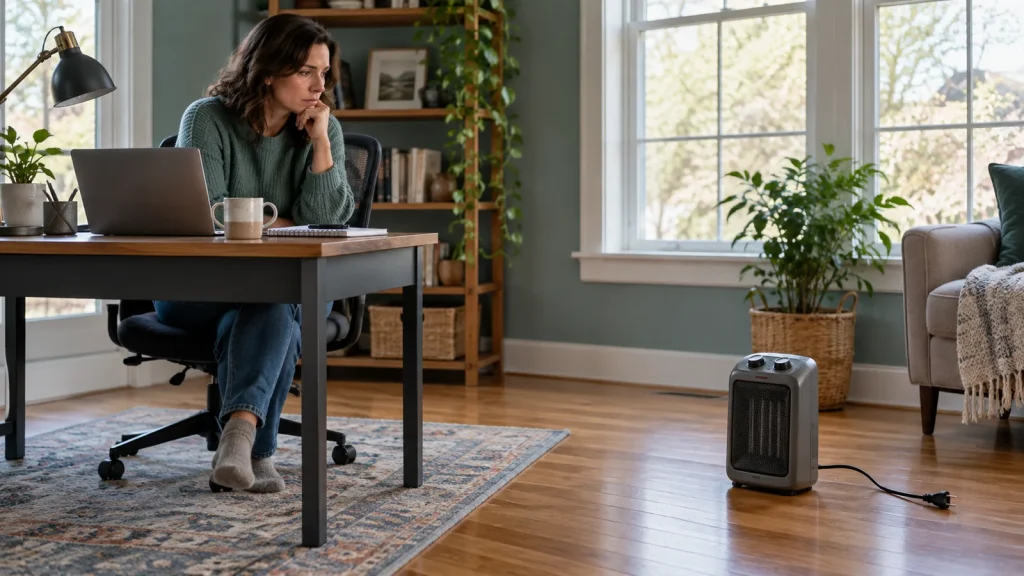
Why Does My Space Heater Trip the Breaker?
Researched and reviewed by Dustin Sosko
Published: October 12, 2026
If your space heater trips the breaker, an overloaded shared circuit is one possible explanation. A 1,500-watt heater draws approximately 12.5 amps at 120 volts, leaving limited capacity for other devices on a 15-amp circuit. However, a damaged heater, short circuit, ground fault, or problem with the electrical installation can also cause a trip.
The first step is identifying what actually lost power. A household breaker tripping is different from the heater shutting itself off while its outlet remains powered.
This guide covers portable electric heaters used on typical U.S. 120-volt household circuits. Hardwired heaters, 240-volt equipment, and RV electrical systems have different requirements.
Stop Using the Heater if You Notice These Warning Signs
Turn the heater off and unplug it only if you can do so safely. Discontinue use if you notice:
- A hot plug, cord, outlet, or outlet faceplate.
- Scorching, discoloration, melted plastic, or damaged insulation.
- A plug that fits loosely or falls out of the outlet.
- Sparks, smoke, or an electrical burning smell.
- Crackling or unusual buzzing at the plug, outlet, or electrical panel.
CPSC advises against operating a suspected damaged heater and recommends professional attention for hot plugs, cords, and outlets.
Do not repeatedly reset a breaker to keep the heater running. If it trips again after an apparent overload has been addressed, leave the heater disconnected and arrange an inspection. If there is active smoke or fire, leave the area and call emergency services.
Did the Breaker Trip, or Did Only the Heater Shut Off?
A silent heater does not automatically mean the household breaker tripped.
| What happened? | What it suggests | Where to start |
|---|---|---|
| Only the heater stopped; other devices on the same circuit still work | Heater controls, a timer, or internal safety protection may have stopped operation | Check the heater’s manual and shutdown symptoms |
| A household breaker tripped and devices on its circuit lost power | Overload or an electrical fault may have operated the breaker | Identify shared loads and warning signs |
| An outlet and nearby outlets lost power, but the panel breaker remains on | An upstream GFCI may have tripped, or another supply problem may exist | Identify the protective device; seek help if uncertain |
| A power strip switched off while the wall outlet still works | The strip’s protection may have operated | Stop using the strip for the heater |
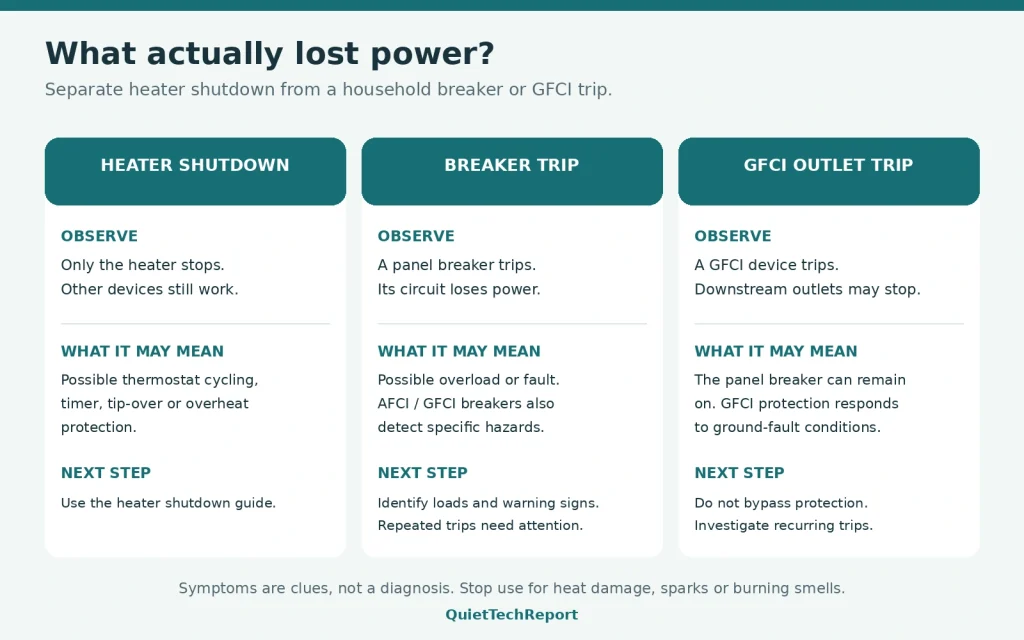
Vornado’s troubleshooting documentation lists household breaker trips, GFCI trips, and internal overheat shutdown separately.
If the circuit remains powered, use our guide to why a space heater keeps shutting off. It covers thermostat cycling, timers, tip-over protection, and overheating.
Other lights remaining on does not prove the heater’s circuit is powered. Lighting and receptacles in the same room may be supplied by different circuits.
Space Heater Tripping Breaker: Quick Troubleshooting Table
Use these symptoms to organize your observations. They are clues, not a definitive diagnosis.
| Symptom | Possible explanation | Safe next action |
|---|---|---|
| Breaker trips when the heater and another substantial appliance run together | Their combined demand may overload the shared circuit | Leave the heater disconnected while identifying other circuit loads |
| Breaker trips immediately when the heater starts | A short circuit, another fault, or heavily loaded circuit may be involved | Stop using the heater; do not keep restarting it |
| Breaker trips after several minutes | Sustained overload or another heat-related electrical problem may be involved | Review shared loads and arrange inspection if the cause is unclear or recurring |
| Breaker trips on low heat | Other loads or a fault may still be present; low-mode wattage varies | Check the manual’s low-power rating; do not assume low heat makes continued use safe |
| Moving the heater to another outlet makes no difference | Both outlets may share the same circuit | Confirm circuit identity rather than guessing from outlet location |
| A GFCI or AFCI device repeatedly trips | Ground-fault or arc-fault protection may be responding | Keep the heater disconnected and have the cause investigated |
| Breaker will not remain on with the heater disconnected | The problem may involve other equipment, wiring, or the breaker | Leave the affected circuit off and contact an electrician |
Why a Space Heater Can Overload a Circuit
A circuit breaker protects the circuit from excessive current. The important number is the combined demand of devices operating on that circuit, rather than how many plugs are connected to one outlet.
For a resistive heater, approximate current is:
Amps = watts ÷ volts
At 120 volts:
| Heater power | Approximate current |
|---|---|
| 200 watts | 1.7 amps |
| 500 watts | 4.2 amps |
| 750 watts | 6.3 amps |
| 900 watts | 7.5 amps |
| 1,500 watts | 12.5 amps |
Use the heater’s nameplate and manual for its actual electrical rating.
A shared-circuit example
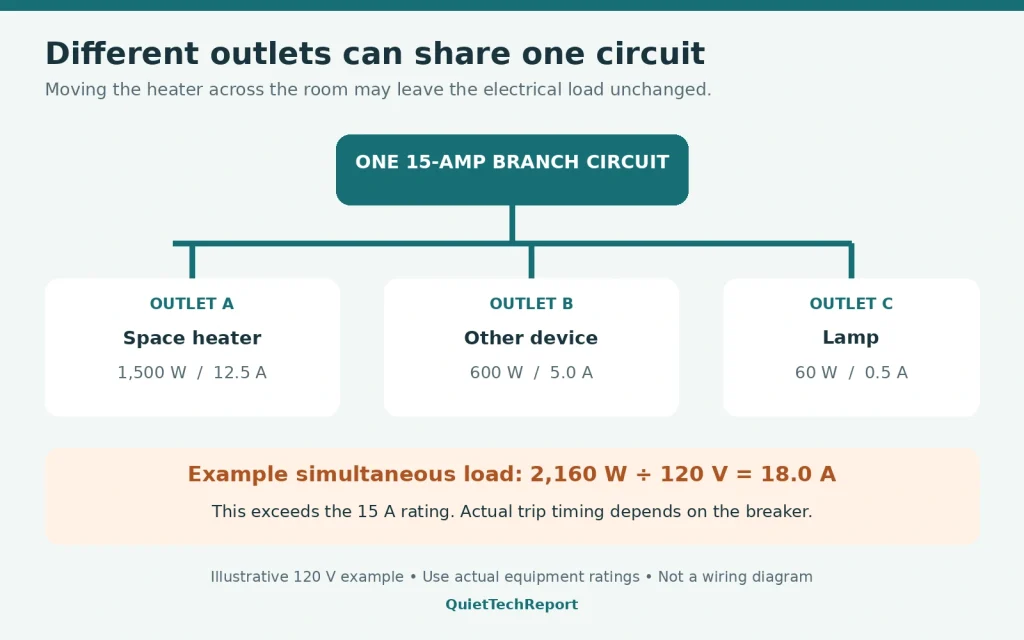
Imagine these devices are operating simultaneously on one 15-amp, 120-volt circuit:
| Device | Illustrative demand |
|---|---|
| Space heater | 1,500 watts |
| Another electrical device | 600 watts |
| Lamp | 60 watts |
| Combined demand | 2,160 watts |
The approximate combined current is:
2,160 watts ÷ 120 volts = 18 amps
That exceeds the circuit’s 15-amp rating. The example explains why a heater can operate by itself but cause a trip when another device starts.
These are illustrative loads, not measurements from specific products. Actual demand and breaker trip timing vary.
Why “nothing else is plugged into this outlet” is not enough
Other outlets may be connected to the same circuit. Their loads count even when they are across the room or in an adjacent room.
Lasko’s circuit guidance specifically discusses the heater’s demand alongside other devices sharing its circuit.
Why Moving to Another Outlet May Not Help
Changing outlets only changes the electrical situation if the new outlet is supplied by a different, suitable circuit.
Two sockets in one duplex receptacle ordinarily share their supply. Separate receptacles can also share a branch circuit.
Useful information includes:
- Which devices lost power during the original trip.
- Existing circuit labels or a reliable circuit map.
- Whether another substantial appliance started immediately before the trip.
- Whether the destination outlet is confirmed to be on another suitable circuit.
Do not assume that an outlet in another room is on a different breaker. If the circuit arrangement is unclear, ask an electrician or property manager.
Do not use an extension cord to reach another circuit. CPSC recommends plugging portable electric heaters directly into wall outlets and avoiding extension cords and power strips.
Why Does the Breaker Trip Immediately?
A trip that occurs as soon as the heater starts deserves attention.
Possible explanations include a fault in the heater or cord, a problem with the circuit, or operation of ground-fault or arc-fault protection. Timing alone cannot identify which one occurred.
Thermal-magnetic breakers have an instantaneous mechanism for sufficiently high short-circuit current and a delayed mechanism for lower overcurrent conditions.
Keep the heater disconnected if it repeatedly causes an immediate trip. Do not move a suspected faulty heater from circuit to circuit to see how many breakers it trips.
Contact the manufacturer about heater inspection or replacement. An electrician can evaluate the receptacle, circuit, breaker, and protective-device indications.
Why Does the Breaker Trip After Several Minutes?
A delayed trip can be consistent with a sustained overload.
For example, a circuit may initially supply a heater and other equipment before the breaker’s thermal mechanism responds. Another appliance may also cycle on after the heater has been running.
However, “it takes a while to trip” does not prove that the wiring or heater is sound.
Record what was operating and approximately how long the heater ran. That information can help an electrician investigate a recurring problem. Avoid repeated trips as a testing method.
Does a 15-amp breaker trip at 12 amps?
Not automatically.
The commonly discussed 80% limit concerns the application of standard-rated breakers to continuous loads. Schneider describes continuous loading as three hours or more and distinguishes this application limit from the breaker’s trip characteristics.
For reference:
- 80% of 15 amps is 12 amps.
- 80% of 20 amps is 16 amps.
These numbers are not automatic trip thresholds or permission to operate a particular heater on an unknown circuit. Circuit suitability depends on the installation, applicable requirements, equipment instructions, and other loads.
A breaker remaining on does not, by itself, establish that the setup is suitable.
Safe Checks Before Using the Heater Again
1. Turn the heater off and disconnect it
Unplug it only if the plug and surrounding area can be handled safely. Keep suspected damaged equipment disconnected.
2. Inspect the exterior
With the heater unplugged and cool, look at its cord, plug, and casing for visible damage.
Check the outlet’s exterior for discoloration or damage. Do not remove its cover or insert tools into it.
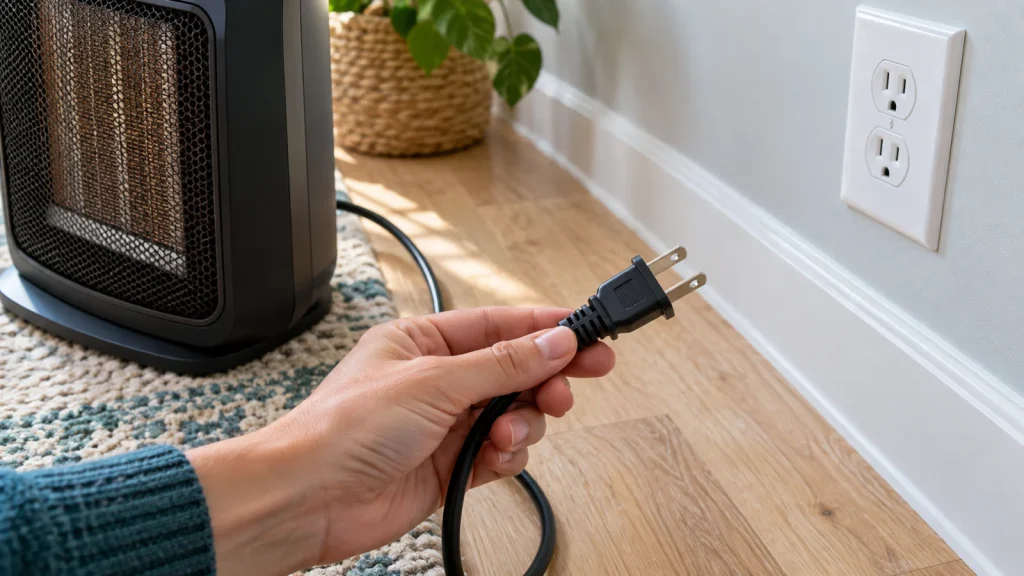
CPSC advises against using an outlet that does not hold the heater’s plug firmly.
3. Read the heater’s electrical rating
Find the model number, voltage, rated wattage, and any stated current rating.
Check the manual for separate high- and low-power ratings. Do not assume that every heater’s low setting is 750 watts.
4. Identify other loads
Note which devices lost power during the trip. Look for substantial loads that may share the circuit, such as another heater, vacuum, hair dryer, or cooking appliance.
Labels give useful starting information, but some devices cycle or draw different amounts in different operating modes.
5. Follow the protective-device instructions
If there were no warning signs, the cause was clearly an overload, and that overload has been removed, follow the breaker manufacturer’s reset instructions.
If you are unsure of the cause, the device will not reset, or another trip occurs, stop and obtain professional help.
Do not remove panel covers, replace breakers, or modify wiring as part of heater troubleshooting.
6. Follow the heater’s placement instructions
Use a suitable wall outlet and the manufacturer’s required clearances. CPSC recommends at least three feet from combustible materials and turning portable heaters off while sleeping.
Does Low Heat Stop a Space Heater from Tripping the Breaker?
A genuine lower-wattage mode can reduce current demand. It may help address a shared-load problem when the heater and electrical installation are otherwise suitable.
For example, at 120 volts:
- A 1,500-watt setting draws approximately 12.5 amps.
- A 900-watt setting draws approximately 7.5 amps.
- A 750-watt setting draws approximately 6.3 amps.
But low heat cannot correct damaged wiring, a loose receptacle, or an electrical fault.
Low heat and a lower thermostat setting are different
A heat-mode selector may change the heater’s wattage. A thermostat controls when heat is needed.
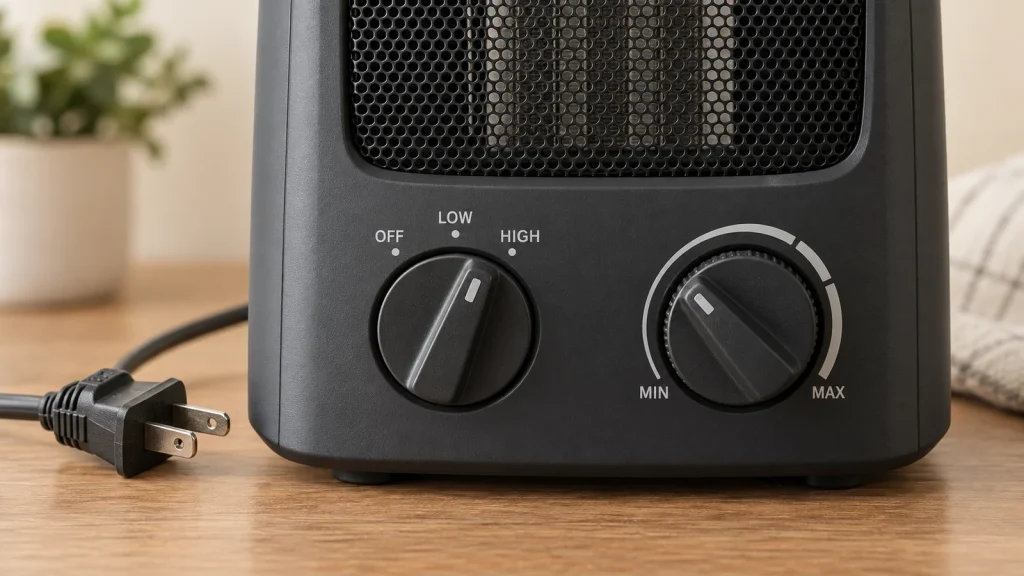
On a simple cycling heater, lowering the thermostat may reduce operating time while leaving the current draw unchanged whenever the heating element is energized.
Some automatic modes also adjust power levels. Lasko documents both thermostat-controlled cycling and a model that changes power output automatically, so the exact behavior depends on the heater.
Check the manual rather than assuming that setting the temperature to 65°F makes the heater draw less current than setting it to 75°F.
Our space heater electricity cost calculator can estimate energy costs from wattage and operating time. It does not determine whether a circuit is safe.
What if it trips on low heat?
Leave the heater disconnected if trips continue.
The circuit may have other loads, the selected mode may draw more power than expected, or a heater or installation fault may be present. A low setting does not rule out these possibilities.
If you only need personal warmth after the electrical issue has been resolved, compare our best low-wattage space heaters. Their lower output also limits whole-room heating.
GFCI and AFCI Trips Are Different from a Simple Overload
A standard thermal-magnetic breaker provides overcurrent protection. Other protective devices can respond to additional hazards.
| Protection | What it addresses | Why it matters here |
|---|---|---|
| Standard circuit breaker | Overloads and short circuits | Excessive shared demand can operate it |
| GFCI | Ground-fault conditions associated with shock hazards | It can trip without a large total electrical load |
| AFCI | Certain electrical arcing conditions associated with fire hazards | A trip should not automatically be blamed on wattage |
| Dual-function AFCI/GFCI breaker | Arc-fault and ground-fault protection, alongside breaker protection | Its diagnostic information may help identify the type of event |
Leviton distinguishes the shock-protection purpose of GFCI devices from arc-fault protection and offers devices combining both functions.
A GFCI receptacle can interrupt power to downstream outlets while the household panel breaker remains on.
If a device has a trip indicator or diagnostic code, record it and consult its exact instructions. Do not assume that codes are universal across brands.
Never bypass GFCI or AFCI protection to keep a heater operating. Recurring trips need investigation.
Will a Different Type of Heater Solve the Problem?
Changing from ceramic to oil-filled or infrared does not automatically reduce electrical demand.
For a 120-volt resistive heater, a rated 1,500-watt input corresponds to approximately 12.5 amps regardless of its heat-delivery style.
A fanless heater may be quieter, but quiet operation does not mean low current draw.
Our oil-filled vs. ceramic vs. infrared heater comparison explains the differences in heat delivery and noise. For heating requirements, see what size space heater you need.
Choose wattage around the heating task and a suitable electrical supply. Do not buy a replacement heater as a substitute for investigating repeated breaker trips.
When to Call an Electrician or Contact the Manufacturer
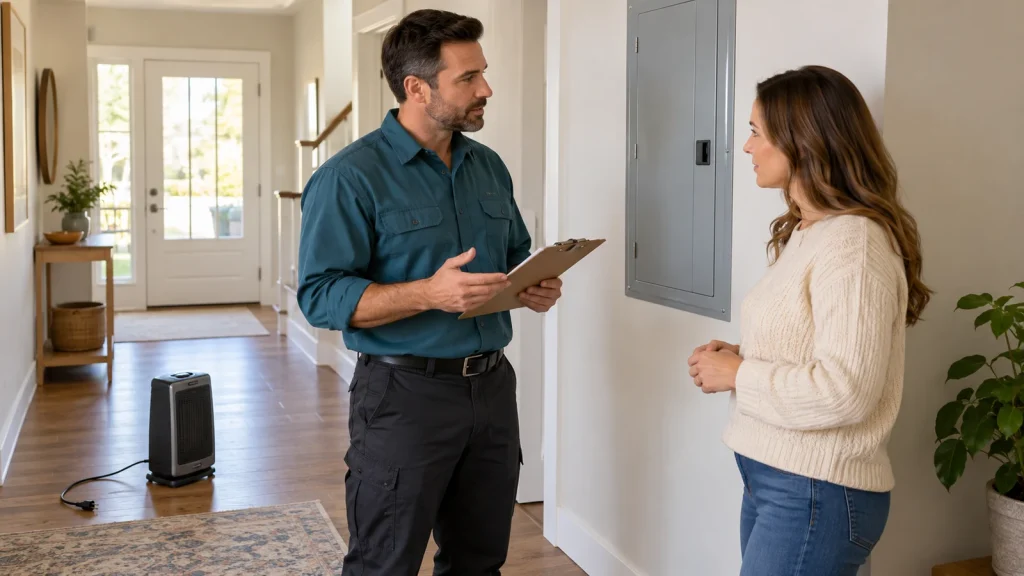
Contact an electrician when:
- The outlet becomes hot, loose, discolored, or damaged.
- The breaker trips again after an apparent overload has been addressed.
- The circuit will not remain powered with the heater disconnected.
- You cannot identify the circuit or its other loads.
- GFCI or AFCI protection repeatedly operates.
- You need a suitable additional circuit for regular supplemental heating.
Contact the heater manufacturer when the heater or cord is damaged, the heater appears to trigger recurring trips, or its operation differs from the manual.
Both may be needed when the cause is unclear.
If you rent your home
Report repeated trips and outlet damage to the landlord or property manager. Provide:
- Heater model and rated wattage.
- Selected heat mode.
- Approximate time before the trip.
- Other devices that lost power.
- Any visible damage or protective-device indication.
Keep the heater disconnected while the issue is investigated. Do not alter the outlet, wiring, or breaker yourself.
Frequently Asked Questions
Can a 1,500-watt heater trip a 15-amp breaker?
Yes. It draws approximately 12.5 amps at 120 volts, and other simultaneous circuit loads can raise the total demand. A fault can also cause a trip. The heater’s wattage alone does not establish the circuit’s suitability.
Can a space heater trip a 20-amp breaker?
Yes. A 20-amp rating does not eliminate overloads or electrical faults. Other loads and any ground-fault or arc-fault protection still matter.
Can two space heaters run on one circuit?
Two 1,500-watt heaters draw approximately 25 amps combined at 120 volts. That exceeds both 15-amp and 20-amp circuit ratings. Different outlets do not help if they share the same circuit.
Will a surge protector prevent the breaker from tripping?
No. It does not increase the circuit’s capacity. Plug portable electric heaters directly into appropriate wall outlets, following their instructions.
Should I replace the breaker with a larger one?
No. A larger breaker must not be used as a shortcut for keeping a heater running. An electrician must evaluate the wiring and installation before making changes.
Why did the heater work last winter but trip the breaker this year?
The situation may have changed: additional loads, different settings, damaged equipment, or an electrical-installation problem may be involved. Previous operation does not prove the present setup is sound.
Does cleaning the heater fix a breaker trip?
Cleaning may help with a heater’s internal overheating shutdown, but it does not establish the cause of a household breaker trip. If only the heater stops while the outlet stays powered, use the heater shutdown troubleshooting guide.
Sources and Research Method
This guide was researched using federal safety guidance and manufacturer documentation checked October 12, 2026. It does not report hands-on electrical fault testing or an inspection of your home.
The diagrams are explanatory examples. The photographic-style images are AI-generated illustrations, not photographs of tested products or an actual service visit.
Primary references:
- CPSC: Reducing Fire Hazards for Portable Electric Heaters
- Lasko: Learn About Your Home’s Circuits to Run Space Heaters Safely
- Schneider Electric: How a Thermal-Magnetic Trip Unit Works
- Schneider Electric: Standard-Rated and 100%-Rated Breakers
- Leviton: Dual-Function AFCI/GFCI Protection
- Vornado VHEAT Owner’s Guide
For related buying guides, comparisons, and tools, explore our Quiet Space Heaters hub.