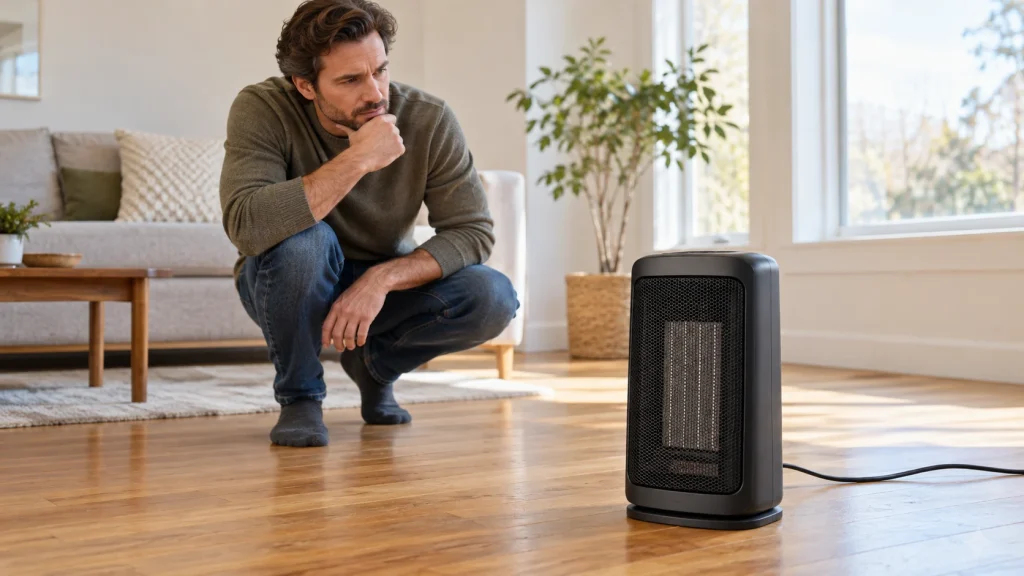
Why Is My Space Heater Making Noise? Clicking, Popping, Buzzing & Rattling
Researched and reviewed by Dustin Sosko
Published: October 12, 2026
Last updated: October 12, 2026
A space heater making noise is not automatically malfunctioning. A single click when heating starts or stops, light ticks as metal warms or cools, and steady airflow from a fan can be expected operating sounds.
The important clues are what the sound resembles, when it happens, where it comes from, and whether it has changed. New buzzing, persistent rattling, scraping, or crackling accompanied by burning odor or unusual heat needs attention.
This guide covers portable electric heaters, including oil-filled radiators, ceramic fan heaters, and electric infrared heaters. Sound alone cannot establish that a heater is safe or identify a faulty component.
For buying guides, heater comparisons, and useful tools, explore our quiet space heater guides and calculators.
When to Stop Using a Noisy Space Heater
Stop using the heater if the noise occurs with:
- Smoke, visible sparks, or a persistent burning smell.
- A hot power cord or plug.
- Melting, discoloration, or visible damage.
- A loose-fitting plug or concerning noise at the outlet.
- New grinding or scraping, particularly if airflow becomes weak or stops.
- Repeated protective shutdowns or breaker trips.
Switch the heater off and disconnect power only if you can do so safely. Do not handle a sparking or damaged connection. If there is an active fire, leave the area and call emergency services.
CPSC advises disconnecting a heater with a hot cord or plug and contacting an authorized repair person. An outlet problem requires a qualified electrician; moving the heater does not repair the original connection.
If the noise is accompanied by a household breaker trip, our space heater breaker-trip guide explains the separate circuit-power problem and when to seek professional help.
Dreo’s Atom Core DR-HSH031 manual also identifies damaged power connections, loud noise, unusual smell, and excessive heat as signs requiring troubleshooting or customer support.

Space Heater Noise: Find Your Sound
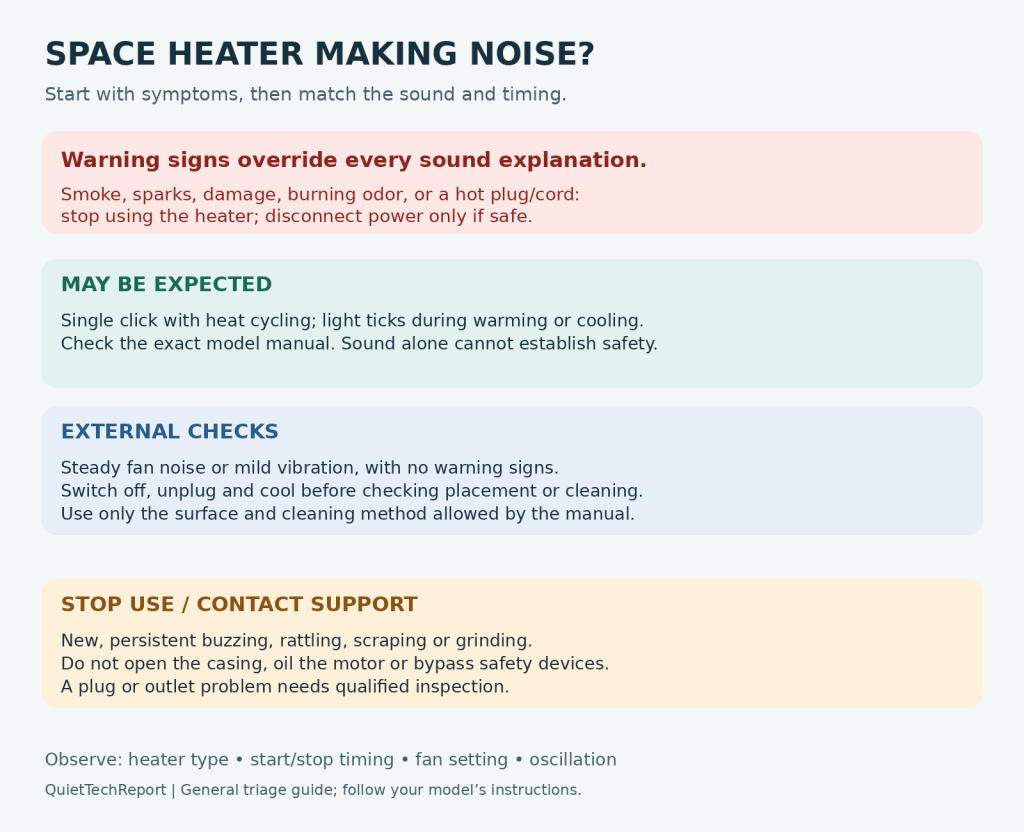
Use this table to choose your first check. Warning signs take priority over any explanation of an expected sound.
| Sound | When it happens | What it may mean | First action |
|---|---|---|---|
| One click | Heating starts or stops | Thermostat or switching action | Compare it with normal heat cycling and the manual |
| Light ticking or pinging | Warming up or cooling down | Expansion or contraction of metal parts | Note whether it fades as temperature stabilizes |
| Brief radiator crackling | An oil-filled heater warms up | An operating sound described by some manufacturers | Check the model’s instructions |
| Steady rushing or whirring | Fan operates | Airflow and fan operation | Compare permitted settings |
| New buzzing or persistent crackling | During operation | Vibration or an electrical problem cannot be distinguished by sound alone | Stop use if unexplained and contact support |
| Rattling, scraping, or grinding | Fan runs | Placement or a mechanical problem may be involved | Switch off, unplug, cool, and inspect externally |
| Clicking or creaking | Only while oscillating | Rotation mechanism or base may be involved | Note the pattern and seek model-specific guidance |
| Buzzing or sizzling near the plug | While connected or operating | A connection problem may be involved | Stop use and arrange qualified inspection |
Match the sound with its timing and accompanying symptoms. This guide helps choose a next step; it does not confirm electrical safety.
Why Is My Space Heater Clicking?
Clicking is easier to interpret when you distinguish a single switching sound from repeated ticks or rapid chatter.
A single click when heating starts or stops
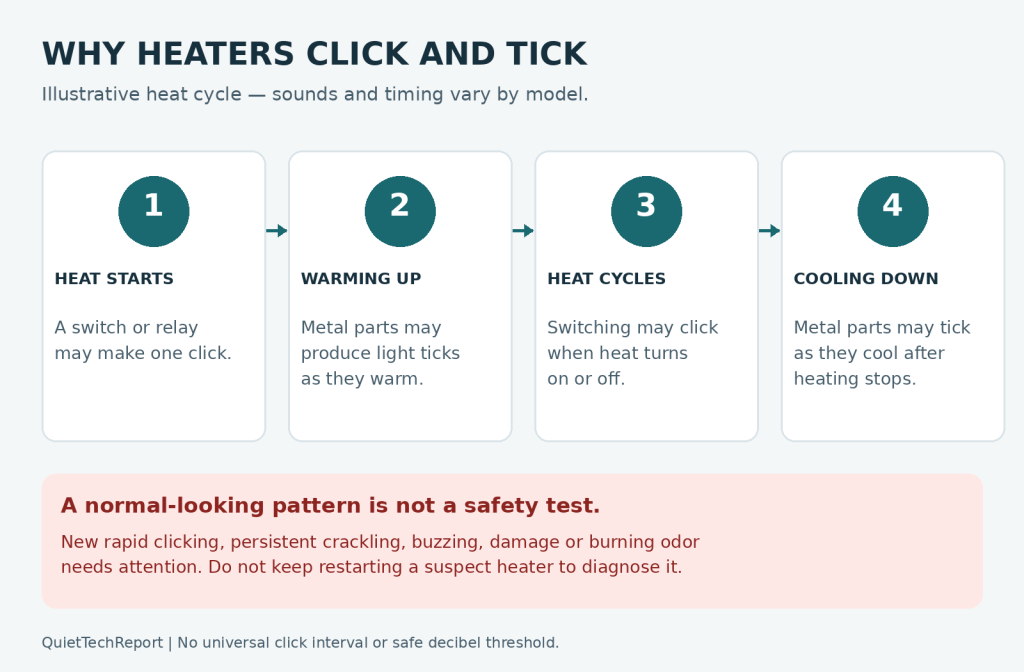
Some heaters have thermostats or switching components that click when the heating circuit changes state.
De’Longhi radiator instructions, for example, describe an audible click when adjusting the thermostat. An occasional click associated with heat cycling can therefore be part of the model’s intended operation.
Note whether:
- The click happens as heating begins or stops.
- The pattern has remained consistent since purchase.
- The manual describes the sound.
- There are any other symptoms.
A heater may remain powered on while its thermostat cycles the heating element. Depending on the design, its fan may stop, continue, or change speed.
Light ticks while the heater warms or cools
Metal parts expand as they heat and contract as they cool. That movement can produce slight ticking or pinging.
Dimplex identifies slight clicking or pinging from thermal expansion and contraction as an expected sound in its electric-heater guidance. Loud or persistent noise deserves additional attention.
Rapid or newly changed clicking
Rapid repeated clicking should not be dismissed as ordinary thermostat operation simply because an occasional click is expected.
If the clicking is new, persistent, or accompanied by flickering, unusual heat, odor, or interruptions, stop using the heater and contact its manufacturer.
There is no universal number of clicks per minute that establishes safe operation.
If the clicking accompanies repeated shutdowns, our guide to why a space heater keeps shutting off explains how to distinguish normal thermostat cycling from a problem requiring attention.
Why Is My Space Heater Popping or Crackling?
“Popping” and “crackling” describe several different sounds. The heater type and timing matter more than the word alone.
Popping during warming or cooling
A light pop or ping may be related to heated parts expanding or contracting. Check whether it occurs mainly during temperature changes and then settles.
Do not assume that a sharp new bang, repeated loud popping, or a changed pattern has the same explanation.
Crackling from an oil-filled radiator
De’Longhi’s oil-radiator support guidance says a crackling sound can be normal and dissipate during use. That is useful context for its radiators, but it does not establish that every crackling electric heater is safe.
Check:
- Whether your model’s manual describes the sound.
- Whether it settles during operation.
- Whether the sound has recently changed.
- Whether there is leakage, damage, unusual odor, or a power-connection problem.
If a radiator is leaking oil, stop using it and contact the manufacturer.
Does popping mean an oil-filled heater needs more oil?
Do not open the radiator or add oil to quiet it.
De’Longhi states that the oil in its radiators remains for the life of the product and does not need changing or refilling. Noise is not a reason to attempt an oil top-up.
Persistent crackling or sizzling
Do not treat persistent sizzling or crackling near the controls, cord, plug, or outlet as routine metal expansion.
Stop use and seek support or qualified electrical inspection. You cannot reliably identify electrical arcing by comparing the sound with a description online.
Why Is My Space Heater Buzzing or Humming?
First distinguish the heater’s usual fan sound from a new buzz.
Steady fan and airflow noise
A fan heater moves air through the appliance, so a consistent whirring or rushing sound can be expected. Higher settings may produce more noise.
Dreo’s heater support guidance recommends checking whether reducing the setting reduces noise and ensuring the appliance stands on a stable, secure surface.
For ordinary fan noise with no warning signs:
- Use a lower permitted setting if it provides enough warmth.
- Check placement after switching off, unplugging, and cooling.
- Keep intake and outlet openings clear.
- Clean only as the manual directs.
A lower heat setting does not necessarily reduce fan speed on every heater.
To understand how heater design affects airflow and operating sounds, compare oil-filled, ceramic, and infrared heaters.
A new electrical-sounding buzz
A new buzz may involve vibration, but it cannot be diagnosed confidently by listening alone. Do not assume it proves a particular motor, relay, or transformer has failed.
An oil-filled radiator without a fan also needs a different explanation from a ceramic fan heater.
If a buzz is new, persistent, worsening, or accompanied by other symptoms, stop use and contact support. Tell them whether it occurs during heating, standby, fan operation, or oscillation.
Why Is My Space Heater Rattling, Scraping, or Grinding?
A rattle may change with placement or operation. Scraping and grinding deserve particular attention because they can indicate a mechanical problem.
Check placement first
Once the heater is off, unplugged, and cool, check that:
- It stands upright on a surface permitted by the manual.
- Its feet, base, or user-assembled wheels are correctly fitted.
- The cord is not pulling against it.
- It is not touching furniture or another object.
- Required clearances are maintained.
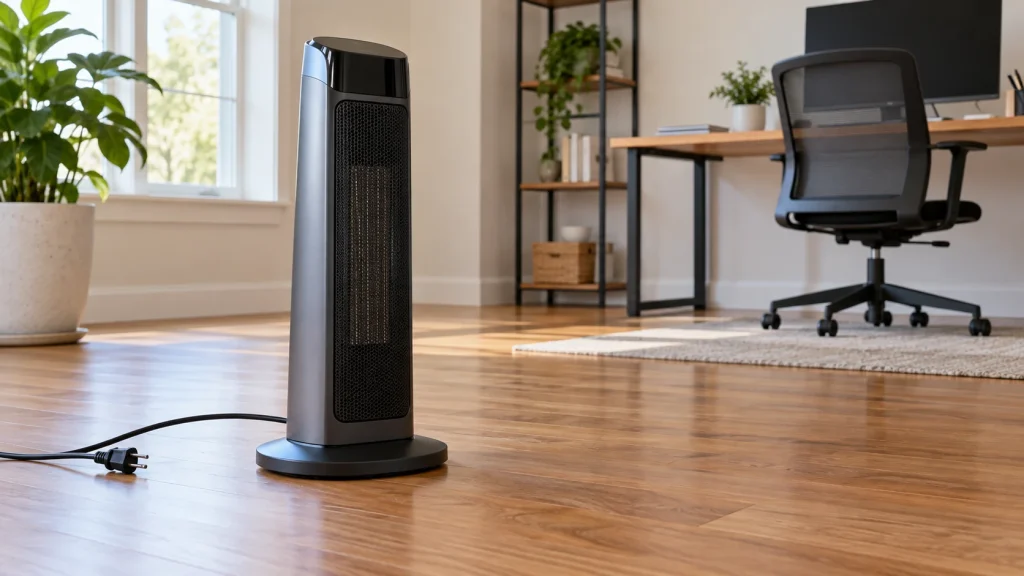
Do not tilt, shake, press on, or hold a running heater to make the noise stop.
Clean accessible vents as instructed
Dust can accumulate around the intake and outlet. Lasko recommends vacuuming its heaters’ vents from outside and advises against opening the unit.
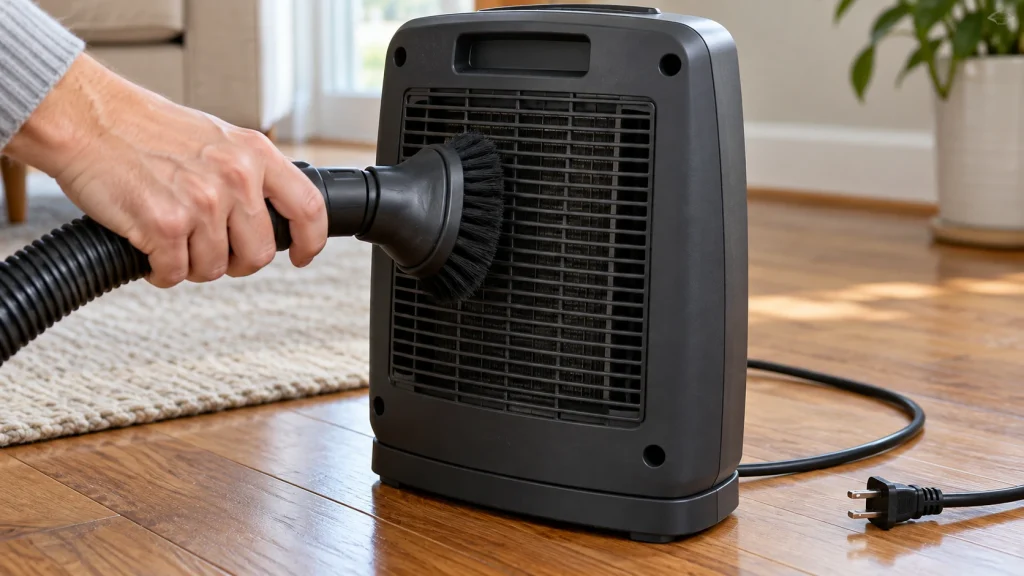
Follow your own model’s cleaning instructions. Do not insert tools through the grille or assume that another brand’s removable grille or filter applies to your heater.
External cleaning does not repair a damaged fan or worn component. Persistent rattling, scraping, or grinding requires manufacturer guidance.
Why Does My Heater Make Noise Only When Oscillating?
A sound that occurs only while the heater rotates provides a useful clue about its base or rotation mechanism.
If you have already observed this pattern, record it for support. If the sound is mild and there are no warning signs, you can compare oscillation on and off using the normal control while supervising the heater. Stop immediately if it scrapes, grinds, or behaves abnormally.
Do not force the heater to rotate by hand.
Should you lubricate a noisy heater?
Do not use general advice to spray oil or lubricant into a heater.
Maintenance requirements differ. The Vornado AVH2 owner’s guide, for example, states that its motor is permanently lubricated and requires no oiling.

Only perform maintenance expressly allowed by your exact model’s instructions. If the guidance is unclear, ask the manufacturer before applying anything.
Why Does My Space Heater Make Noise After Turning Off?
Light ticks after heating stops may occur as metal parts cool and contract.
Distinguish three situations:
- Heating stops: The thermostat may have stopped the element while other functions continue.
- The power button is pressed: Some models have a documented fan cooldown period.
- The heater is unplugged: Electrical operation stops, but retained heat can still produce cooling-related sounds.
Check the manual before assuming fan run-on is expected. Follow any documented shutdown sequence.
A persistent buzz, strong vibration, or other changed sound should not be explained away as cooling. Note how long it continues and contact support if it is unexplained.
Safe Checks You Can Perform Without Opening the Heater
Use this sequence for mild noise without warning symptoms.
- Identify the exact model. Find its rating label and matching manual.
- Note the pattern. Record the sound, timing, setting, and whether oscillation was active.
- Switch off, unplug, and let it cool. Do this before moving, inspecting, or cleaning.
- Inspect externally. Look for damage, blocked vents, an incorrectly fitted base, or contact with nearby objects.
- Clean as instructed. Use only approved methods and user-accessible parts.
- Check permitted placement. Keep it upright, stable, and clear of combustible materials.
- Contact support if the noise persists. Do not repeatedly restart a suspect heater.
CPSC recommends keeping portable heaters at least three feet from combustible materials, connecting electric heaters directly to a wall outlet, and turning them off when sleeping. Maintain any greater clearance required by the manual.
Do not put towels, foam, or an improvised enclosure around the heater to reduce sound. Do not bypass its thermostat, tip-over switch, or overheat protection.
When to Contact the Manufacturer or Replace the Heater
Contact the manufacturer when a sound is new or worsening, persists after permitted external checks, or is accompanied by abnormal operation.
Provide:
- Model number and approximate age.
- A description of the sound and when it occurs.
- Heating mode, fan setting, and oscillation status.
- Any error code, shutdown, odor, or visible damage.
- Cleaning or placement checks already completed.
A recording made during ordinary, safe operation may help support assess the sound. Do not restart a suspect heater just to capture a video.
Check whether the model has been recalled. CPSC advises stopping use of recalled products and following the recalling company’s remedy.
Replacement may be appropriate if the manufacturer cannot offer a suitable repair, damage affects safe operation, or abnormal behavior persists. A heater continuing to produce warmth does not establish that it is safe.
If its sounds are documented and expected but still disruptive, consider a different heater design. Fanless operation removes fan noise, but it does not guarantee freedom from thermostat clicks or temperature-related ticks. If continuous fan noise is your main complaint, our best quiet oil-filled radiator heaters guide compares fanless options, controls, and possible incidental sounds.
For supervised use in a bedroom, compare our quiet space heaters for bedrooms and nurseries, including fanless and compact fan-heater options.
Frequently Asked Questions
Is a clicking space heater dangerous?
A single click associated with thermostat switching can be expected on some models. Rapid repeated clicking, a newly changed pattern, or clicking with odor, damage, or unusual heat requires attention.
Why does my oil-filled heater crackle?
Some manufacturers describe radiator crackling as an expected operating sound. Check the exact model’s guidance. Do not extend that explanation to leakage, persistent electrical-sounding crackling, or damaged connections.
Can I keep using a heater that rattles?
Do not ignore a new persistent rattle. Switch off, unplug, and cool before checking permitted placement and cleaning. If it persists—or includes scraping or grinding—contact support.
Can I put a mat under the heater to reduce vibration?
Only use surfaces or accessories expressly permitted by the manufacturer. Do not add an improvised pad that could affect stability, block airflow, or create a fire hazard.
Is there a safe decibel level for heater noise?
A decibel reading measures sound level; it does not establish electrical or mechanical safety. A quiet fault may still require attention, while ordinary fan operation can be louder.
Our guide to understanding decibels for home appliances explains how to interpret sound ratings when comparing noise levels.
Why does my heater beep when plugged in?
Some heaters use a beep to announce power or acknowledge controls. Lasko documents a plug-in notification beep. Repeated beeps or beeps with an error code should be checked against the model’s manual.
Sources and Research Method
This guide is based on manufacturer manuals, official support guidance, and CPSC safety information checked October 12, 2026. It does not represent hands-on testing of a malfunctioning heater.
The two functional graphics are explanatory illustrations. The two manual images reproduce narrow, unaltered excerpts from the identified PDFs; their instructions should not be applied indiscriminately to other models.